

Microneedling in Istanbul: What to Ask About Suitability, Sessions, Aftercare and Results
A detailed guide to microneedling in Istanbul, covering suitability, conventional versus RF devices, cartridge hygiene, sessions, aftercare, risks and consultation questions.
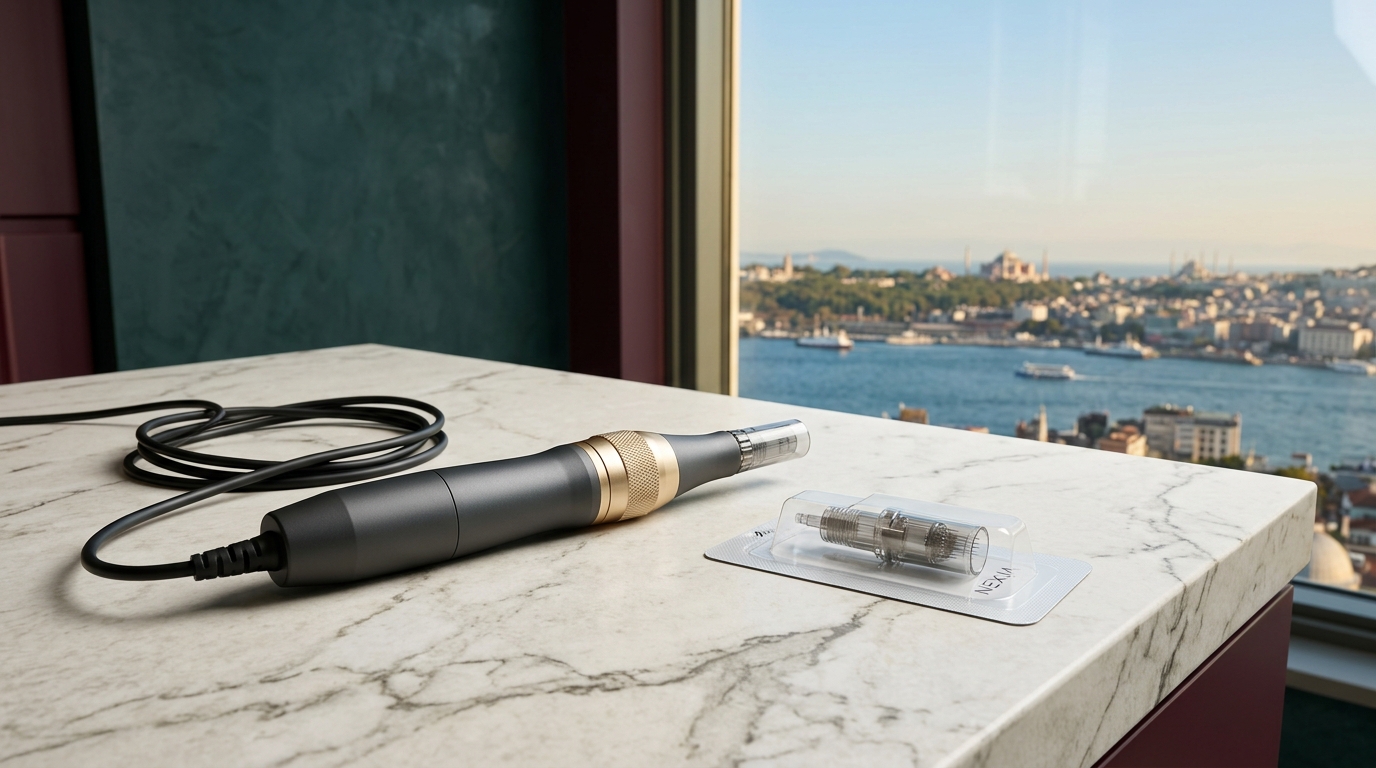
A practical, evidence-aware decision guide for microneedling in Istanbul.
Direct answer: A good microneedling decision starts with suitability, exact device identity, single-use cartridge hygiene, realistic goals and a written recovery plan. Conventional microneedling is not the same as radiofrequency microneedling; Dermapen is not a generic guarantee of model or quality; and no responsible provider can promise a fixed number of sessions, zero downtime or complete scar removal.
This English guide is for residents, expatriates and visitors comparing microneedling in Istanbul. It explains what to ask before booking, how to distinguish treatment categories, what evidence can and cannot establish, and how to plan aftercare without inventing a Nexja protocol. It complements the broader skin treatments in Istanbul guide and the focused acne-scar and facial-treatment comparisons.
The most important sources are the FDA consumer safety overview, the FDA’s detailed microneedling device information, the American Academy of Dermatology patient guidance and the systematic review of microneedling for acne scarring. US regulatory statements are used to define evidence boundaries, not to claim Turkish approval or certify Nexja.
Microneedling decision map
| Question | Useful evidence | What is not enough | Next step |
|---|---|---|---|
| Is my concern suitable? | Current skin examination, history and a concern-specific plan | A social-media before-and-after image | Assessment before payment or treatment |
| Which device is used? | Manufacturer, model, intended use and cartridge documentation | “Dermapen technology” or a pen-shaped photo | Record the exact identity |
| Is it conventional or RF? | Clear explanation of whether energy is delivered | Using both names interchangeably | Compare the correct risk and evidence category |
| How is hygiene managed? | New cartridge each session plus documented cleaning | “Everything is sterile” without process | Ask to see the sealed cartridge |
| How many sessions? | Provisional plan with reassessment criteria | Guaranteed package number | Review response before continuing |
| What happens after? | Written care, warning signs and contact pathway | “No downtime” | Schedule around realistic recovery |
Begin with the concern, not the device name
Microneedling is a procedure category, not a single interchangeable service. A useful consultation begins by naming the concern—such as atrophic acne-scar texture, fine lines, uneven surface quality or another assessed indication—then deciding whether controlled needling is appropriate.
Ask how the concern was identified, what photographs or examination will be used, what improvement would count as meaningful, and what would make the practitioner recommend another route. A device name cannot diagnose active acne, pigment disorders, infection or a scar subtype.
Separate treatment goals from promises. Texture can improve without becoming flawless; pores do not literally open and close; collagen remodelling is gradual; and a good plan includes the possibility that microneedling is not the best option that day.
A practical consultation should convert this principle into a documented decision for the exact skin, area and date. Ask what information would change the plan, who is responsible for escalation, and how the answer will be recorded. If the explanation remains generic, postpone rather than allowing schedule pressure to become consent.
What conventional microneedling does
A motorised pen or another needling device creates controlled punctures. The intended tissue response is different from simple surface exfoliation, which is why depth, cartridge, technique, treatment area and operator training matter.
The FDA describes legally marketed microneedling devices for specific uses in adults, but United States clearance is device- and indication-specific and does not prove that an unnamed device in Istanbul has the same status. Ask for the exact device identity and local documentation rather than accepting a general FDA claim.
Conventional microneedling should also be distinguished from home rollers. A consumer product with short blunt projections, a professional motorised pen and an energy-delivering device do not have the same risk profile, evidence base or operating requirements.
A practical consultation should convert this principle into a documented decision for the exact skin, area and date. Ask what information would change the plan, who is responsible for escalation, and how the answer will be recorded. If the explanation remains generic, postpone rather than allowing schedule pressure to become consent.
Dermapen is a brand-style term, not the whole category
People often use Dermapen as shorthand for pen-shaped microneedling. That wording can hide important differences between an authentic named system, another professional pen and a generic device.
Ask for the manufacturer and model actually used, the cartridge type, whether the cartridge is new for every person and every session, and how reusable parts are cleaned. Do not infer specifications from a photograph, a pen shape or a clinic menu label.
For this guide, “conventional microneedling” means mechanical needling without radiofrequency energy. If Nexja confirms a particular model, claims should still be limited to its documented intended use and the practitioner’s lawful scope.
A practical consultation should convert this principle into a documented decision for the exact skin, area and date. Ask what information would change the plan, who is responsible for escalation, and how the answer will be recorded. If the explanation remains generic, postpone rather than allowing schedule pressure to become consent.
Conventional and RF microneedling are not interchangeable
Radiofrequency microneedling combines needle insertion with delivered energy. Conventional microneedling does not deliver that heat. Evidence, settings, contraindications, risks and recovery therefore cannot be copied from one category to the other.
The FDA highlighted potential serious complications reported with certain uses of RF microneedling in 2025. That communication is not a statement that all RF treatments are unsafe, and it is not a reason to transfer RF outcomes to a conventional pen. It is a reason to ask exactly which category is being offered.
If a website or consultation switches casually among microneedling, RF microneedling, collagen induction and fractional technology, pause and request a precise explanation. The informed decision depends on the actual device and protocol, not a broad marketing family.
A practical consultation should convert this principle into a documented decision for the exact skin, area and date. Ask what information would change the plan, who is responsible for escalation, and how the answer will be recorded. If the explanation remains generic, postpone rather than allowing schedule pressure to become consent.
Acne scars require scar typing and active-acne control
Atrophic scars may include ice-pick, rolling and boxcar patterns, often in combination. Raised scars and keloids behave differently. The AAD explains that treatment planning depends on scar type, skin tone, number of scars, expectations and other individual factors.
Active inflammatory acne is not the same target as established atrophic scarring. A plan may begin with controlling breakouts to reduce new scars. Needling through inflamed, infected or broken skin should not be treated as a routine shortcut.
Ask whether one modality is expected to address every scar. Deep narrow scars, tethered rolling scars and broader shallow depressions may call for different or combined approaches. A balanced consultation explains why microneedling may be one component rather than a universal answer.
A practical consultation should convert this principle into a documented decision for the exact skin, area and date. Ask what information would change the plan, who is responsible for escalation, and how the answer will be recorded. If the explanation remains generic, postpone rather than allowing schedule pressure to become consent.
Pigmentation and uneven tone need a different diagnostic question
Brown marks after acne, melasma, sun-related change and post-inflammatory hyperpigmentation can look similar to a non-specialist but do not necessarily respond to the same plan. Microneedling should not be chosen solely because the word “pigmentation” appears in advertising.
Ask whether the visible colour change has been medically assessed when appropriate, whether active inflammation is present, and how the risk of post-inflammatory darkening or lightening is considered. The FDA lists pigmentation changes among less common risks.
Sun protection, product review and realistic scheduling matter in Istanbul, especially around outdoor travel. A procedure cannot substitute for diagnosing a changing lesion, unexplained patch or condition that needs medical care.
A practical consultation should convert this principle into a documented decision for the exact skin, area and date. Ask what information would change the plan, who is responsible for escalation, and how the answer will be recorded. If the explanation remains generic, postpone rather than allowing schedule pressure to become consent.
Fine lines and general skin quality
Some cleared microneedling devices have specific facial-wrinkle indications, and clinical literature discusses texture and rejuvenation. That does not justify promising a facelift, permanent pore removal or a fixed percentage of collagen increase.
Clarify the exact area, the outcome measure and the time horizon. Fine surface changes, movement-related lines, volume loss and laxity are different concerns. A treatment aimed at one may have little effect on another.
Ask how photographs will be standardised and when progress will be judged. Lighting, makeup, hydration and camera distance can create dramatic apparent changes that are not treatment effects.
A practical consultation should convert this principle into a documented decision for the exact skin, area and date. Ask what information would change the plan, who is responsible for escalation, and how the answer will be recorded. If the explanation remains generic, postpone rather than allowing schedule pressure to become consent.
Who may need medical review or postponement
The FDA advises that microneedling may not suit people with active infection or rash, immune suppression, uncontrolled diabetes, bleeding disorders, anticoagulant therapy, certain skin diseases, keloid history, current or recent isotretinoin exposure, pregnancy or breastfeeding, and other listed circumstances.
This is not a self-screening checklist that grants clearance when every box appears negative. Medical history, medicines, allergies, prior reactions and the planned device still need review by an appropriately trained professional.
Do not stop anticoagulants, acne medication or another prescribed treatment to keep a cosmetic booking. The prescriber and treating professional should guide any change; postponing an elective procedure is safer than altering necessary care independently.
A practical consultation should convert this principle into a documented decision for the exact skin, area and date. Ask what information would change the plan, who is responsible for escalation, and how the answer will be recorded. If the explanation remains generic, postpone rather than allowing schedule pressure to become consent.
Skin tone, tanning and pigment history
Microneedling is often discussed as usable across skin tones, but individual pigment behaviour still matters. Some FDA-authorised devices were not studied in darker skin types, and the agency notes a risk of hyperpigmentation or hypopigmentation.
Report whether irritation, acne or previous procedures leave dark or light marks. Disclose recent tanning, sunburn and planned sun exposure. A short trip to Istanbul can include substantial incidental exposure on terraces, ferries and walking routes.
Ask how the provider adjusts planning for your baseline tone and pigment history. “Suitable for all skin types” is not a complete assessment and should never erase a history of keloids, active dermatitis or previous prolonged pigmentation.
A practical consultation should convert this principle into a documented decision for the exact skin, area and date. Ask what information would change the plan, who is responsible for escalation, and how the answer will be recorded. If the explanation remains generic, postpone rather than allowing schedule pressure to become consent.
Medication and product review
Bring exact names and photographs of prescription products, retinoids, exfoliating acids, benzoyl peroxide, hydroquinone, topical steroids, antibiotics, supplements and products that cause peeling or stinging. Vague labels such as “acne cream” are not enough.
Tell the provider about isotretinoin, anticoagulants, immune-modifying medicines, steroid use and allergies to stainless steel, adhesives or topical anaesthetics. Relevance varies, so complete disclosure is more useful than editing the list yourself.
Do not copy a friend’s stop schedule. A product may be prescribed for a reason, and the correct pause or continuation decision depends on formulation, area, skin condition and professional advice.
A practical consultation should convert this principle into a documented decision for the exact skin, area and date. Ask what information would change the plan, who is responsible for escalation, and how the answer will be recorded. If the explanation remains generic, postpone rather than allowing schedule pressure to become consent.
Recent procedures and treatment stacking
Disclose peels, lasers, light treatments, injections, surgery, waxing, facial treatments and previous microneedling, with dates and recovery. A quiet-looking surface does not always prove that the barrier or pigment response is ready for another procedure.
A short travel window is not a clinical reason to stack several treatments. Combining procedures can increase irritation and make it difficult to identify the cause of an adverse reaction.
Ask which treatment owns the main goal, which combinations have evidence for that goal, what order is proposed, and what recovery interval is needed. “More treatments in one appointment” is not automatically better value.
A practical consultation should convert this principle into a documented decision for the exact skin, area and date. Ask what information would change the plan, who is responsible for escalation, and how the answer will be recorded. If the explanation remains generic, postpone rather than allowing schedule pressure to become consent.
Products applied during or after needling
Microneedling creates channels that can change exposure to substances placed on the skin. The FDA states that microneedling devices are not authorised for delivery of cosmetics, topical medicines, vitamin solutions, drugs or blood products into the skin.
That United States statement does not define every Turkish rule, but it is an important evidence boundary. Ask for the exact product name, ingredients, intended use, sterility information and reason for combination. Do not accept “serum” or “exosome” as sufficient identity.
A product that is safe on intact skin is not automatically established as safe for use with needling. Marketing claims about absorption, stem cells or growth factors require product-specific evidence and lawful professional oversight.
A practical consultation should convert this principle into a documented decision for the exact skin, area and date. Ask what information would change the plan, who is responsible for escalation, and how the answer will be recorded. If the explanation remains generic, postpone rather than allowing schedule pressure to become consent.
Exosomes, PRP and combination claims
PRP and so-called exosome products are distinct categories. They should not be blended into a single “regenerative” claim. Evidence for a specific adjunct cannot be transferred to an unidentified serum or cosmetic.
If a combination is proposed, ask whether the product is autologous or manufactured, who prepares it, how traceability is maintained, what adverse-event plan exists, and which evidence supports that exact combination.
Declining an add-on should not make the basic consent conversation disappear. It is reasonable to choose a simpler plan when product identity, regulatory status or evidence is uncertain.
A practical consultation should convert this principle into a documented decision for the exact skin, area and date. Ask what information would change the plan, who is responsible for escalation, and how the answer will be recorded. If the explanation remains generic, postpone rather than allowing schedule pressure to become consent.
Hygiene and single-use cartridges
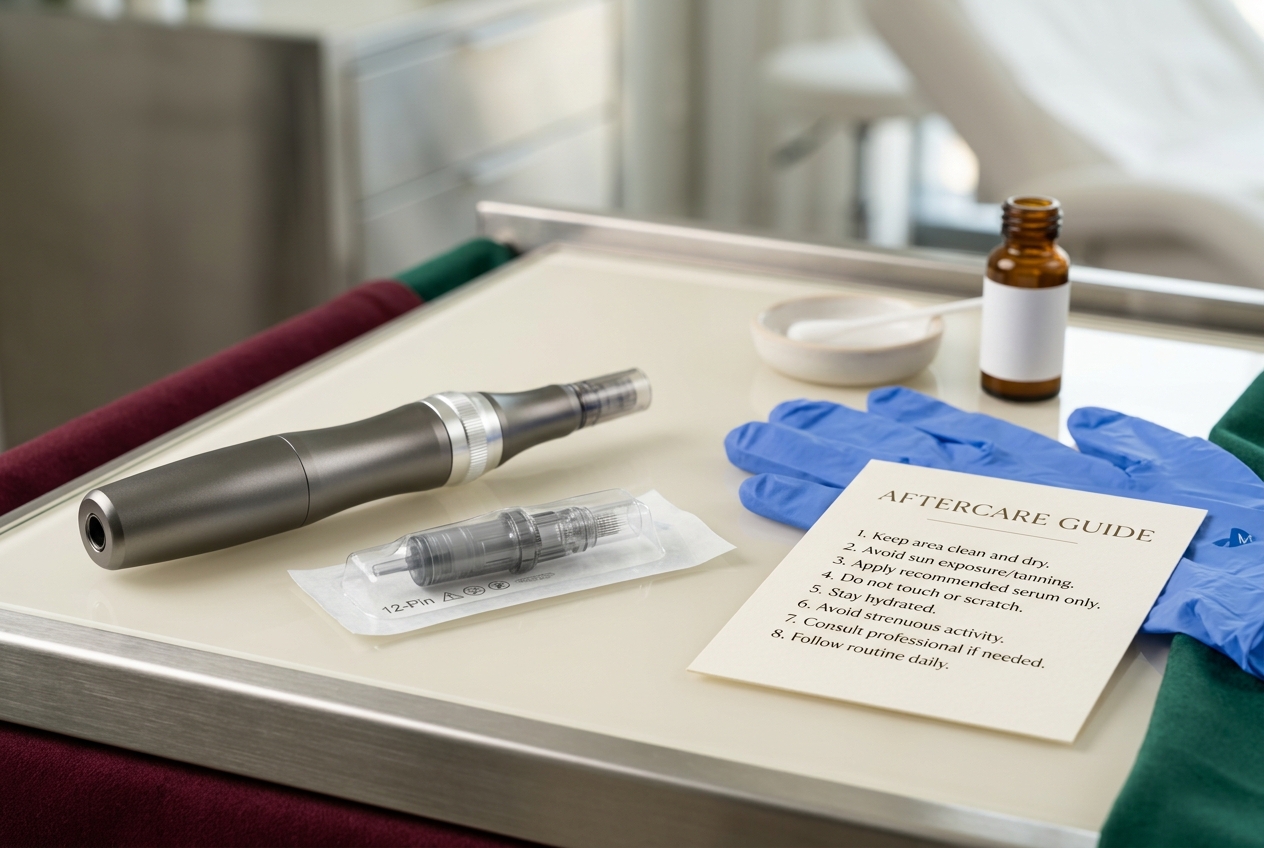
A new needle cartridge should be used for every patient and every treatment session. The FDA says reuse is unsafe even if a cartridge is cleaned. Packaging should be intact and opened according to protocol.
Ask how hand hygiene, gloves, skin preparation, treatment surfaces and reusable device components are managed. Cleaning and disinfection should follow manufacturer instructions; a disposable tip does not make the rest of the workflow irrelevant.
Hygiene questions are not an accusation. Clear answers demonstrate that the clinic can explain infection-control steps without relying on vague reassurance.
A practical consultation should convert this principle into a documented decision for the exact skin, area and date. Ask what information would change the plan, who is responsible for escalation, and how the answer will be recorded. If the explanation remains generic, postpone rather than allowing schedule pressure to become consent.
Pain control and topical anaesthesia
Topical anaesthesia is commonly used in professional microneedling, but product, concentration, area, contact time, occlusion and allergy history matter. Stronger or longer is not automatically safer.
Never apply an unreviewed high-strength numbing cream over a large area before arrival. Tell the provider about reactions to local anaesthetics, adhesives or topical products and ask whether any preparation should happen at home.
Pain varies with area and settings. A promise of “completely painless” is less useful than an explanation of comfort measures, stop signals and what sensation should prompt reassessment.
A practical consultation should convert this principle into a documented decision for the exact skin, area and date. Ask what information would change the plan, who is responsible for escalation, and how the answer will be recorded. If the explanation remains generic, postpone rather than allowing schedule pressure to become consent.
What happens during an appointment
A careful visit includes history review, current-skin examination, confirmation of the goal, consent, photography policy, cleansing, device and cartridge checks, treatment, immediate assessment and written aftercare.
The provider may adapt the depth or pass pattern by area, but specific technical parameters should not be selected by the client from social media. Ask how decisions are made rather than demanding a number that may be inappropriate.
You can pause or withdraw consent at any point. Paying a deposit, travelling or signing a form does not remove the need for ongoing understandable communication.
A practical consultation should convert this principle into a documented decision for the exact skin, area and date. Ask what information would change the plan, who is responsible for escalation, and how the answer will be recorded. If the explanation remains generic, postpone rather than allowing schedule pressure to become consent.
Immediate responses and expected downtime
Redness, tightness, dryness, roughness, itching, peeling, discomfort, burning, bruising, bleeding or crusting can occur. Duration varies by individual, area and treatment. A precise “no downtime” guarantee is not appropriate.
Plan around the possibility that the skin will look and feel treated for several days. Avoid scheduling immediately before a wedding, filming, important meeting or long outdoor itinerary when visible recovery would be difficult.
Ask which effects are expected, how long they commonly last in that practice, and which changes require contact. Written thresholds are more useful than “message us if worried.”
A practical consultation should convert this principle into a documented decision for the exact skin, area and date. Ask what information would change the plan, who is responsible for escalation, and how the answer will be recorded. If the explanation remains generic, postpone rather than allowing schedule pressure to become consent.
Aftercare: protect, simplify and observe
Follow the written plan for cleansing, moisturising, sun protection, makeup, exercise, heat, swimming and active ingredients. Do not improvise with acids, retinoids, scrubs, fragranced oils or a new “healing” serum.
The AAD notes that patients may be advised to wait before applying makeup, while the FDA notes increased sensitivity to sunscreen, makeup, moisturisers and products containing retinol, glycolic acid, menthol, capsaicin or alcohol. Individual instructions govern.
Use clean hands and avoid picking flakes or crusts. Aftercare supports recovery but cannot guarantee the absence of complications or a particular result.
A practical consultation should convert this principle into a documented decision for the exact skin, area and date. Ask what information would change the plan, who is responsible for escalation, and how the answer will be recorded. If the explanation remains generic, postpone rather than allowing schedule pressure to become consent.
Warning signs and escalation
Increasing pain, spreading redness, pus, fever, blistering, marked swelling, persistent bleeding, darkening or lightening that concerns you, eye symptoms or a suspected herpes flare deserve prompt contact and may require medical assessment.
Do not rely only on edited photographs or delayed messaging when symptoms are severe or worsening. Ask before treatment where urgent local care should be sought and who can review you after hours.
International visitors should retain the device and product details, treatment date and clinic contact information. If another clinician needs to assess you, accurate records are more useful than a marketing treatment name.
A practical consultation should convert this principle into a documented decision for the exact skin, area and date. Ask what information would change the plan, who is responsible for escalation, and how the answer will be recorded. If the explanation remains generic, postpone rather than allowing schedule pressure to become consent.
How many sessions and how far apart
The FDA notes that more than one procedure may be needed and improvement can be temporary. Session number depends on the concern, scar pattern, response, settings, recovery and whether other treatments are part of the plan.
A package should not replace reassessment. Ask what will be reviewed before each session, how photographs will be standardised, what lack of progress means and when the plan would change.
Do not compress intervals to fit a holiday. Tissue response takes time, and the practitioner’s individual plan should govern spacing.
A practical consultation should convert this principle into a documented decision for the exact skin, area and date. Ask what information would change the plan, who is responsible for escalation, and how the answer will be recorded. If the explanation remains generic, postpone rather than allowing schedule pressure to become consent.
How results should be judged
Results should be judged with consistent photographs, lighting, angle, expression and timing. For scars, the same light direction is particularly important because shadows can exaggerate or hide depressions.
Agree on the main outcome before treatment. “Better skin” is too broad; a plan might prioritise scar visibility, texture, fine lines or another assessed feature. No single score captures every meaningful change.
Improvement does not mean complete removal. A responsible review distinguishes gradual change, natural variation and photographic artefact from a guaranteed transformation.
A practical consultation should convert this principle into a documented decision for the exact skin, area and date. Ask what information would change the plan, who is responsible for escalation, and how the answer will be recorded. If the explanation remains generic, postpone rather than allowing schedule pressure to become consent.
Comparing microneedling with fractional CO2 laser
Microneedling and fractional CO2 resurfacing use different mechanisms and recovery profiles. Evidence from one study or one scar pattern cannot identify a universal winner.
The right comparison includes scar type, skin tone, pigmentation history, downtime tolerance, previous treatment and access to follow-up. Day 5 of the Nexja Journal addresses this two-treatment decision in depth.
Use the microneedling versus fractional CO2 guide for that focused comparison rather than expecting this page to prescribe a method.
A practical consultation should convert this principle into a documented decision for the exact skin, area and date. Ask what information would change the plan, who is responsible for escalation, and how the answer will be recorded. If the explanation remains generic, postpone rather than allowing schedule pressure to become consent.
Comparing microneedling with Hydrafacial
Hydrafacial-style surface care and microneedling are not stronger and weaker versions of the same treatment. One centres on surface cleansing, exfoliation and hydration; the other creates controlled punctures to prompt a tissue response.
Choose according to the concern, barrier condition, recovery tolerance and assessment—not because one is trending. Combining or sequencing them requires a reason and enough recovery time.
Read the Hydrafacial versus microneedling decision guide for a full comparison.
A practical consultation should convert this principle into a documented decision for the exact skin, area and date. Ask what information would change the plan, who is responsible for escalation, and how the answer will be recorded. If the explanation remains generic, postpone rather than allowing schedule pressure to become consent.
Istanbul planning for residents
Residents can plan a course around work, sun exposure, exercise, events and follow-up. The advantage is not a guarantee of better results; it is easier continuity when the same team can reassess the skin.
Ask how appointments are documented and whether the same device and protocol can be tracked over time. Report product, medicine or health changes before each session.
Budget for the assessed course rather than comparing only one promotional session. Include aftercare and the possibility that the plan changes or stops.
A practical consultation should convert this principle into a documented decision for the exact skin, area and date. Ask what information would change the plan, who is responsible for escalation, and how the answer will be recorded. If the explanation remains generic, postpone rather than allowing schedule pressure to become consent.
Istanbul planning for visitors
Visitors should avoid treating microneedling as an attraction that must fit a final afternoon. Allow time for assessment, recovery instructions and access to review before departure.
Consider flights, hotel hygiene, sun exposure, swimming, hammam, exercise and outdoor plans. None automatically forbids treatment, but they can make aftercare harder.
Ask who will support you after leaving Türkiye, what records you receive, and when local medical care is more appropriate than remote follow-up.
A practical consultation should convert this principle into a documented decision for the exact skin, area and date. Ask what information would change the plan, who is responsible for escalation, and how the answer will be recorded. If the explanation remains generic, postpone rather than allowing schedule pressure to become consent.
Choosing a provider in Istanbul
Compare training, scope, device identity, cartridge policy, assessment, consent, documentation, aftercare and complication planning. Price alone cannot show whether these systems are present.
Ask who performs the procedure and who evaluates medical concerns. Do not infer a dermatologist, physician or specific qualification unless the clinic verifies it.
A provider should be willing to postpone when skin is unsuitable. “Everyone is a candidate” and “zero risk” are warning signs, not premium service.
A practical consultation should convert this principle into a documented decision for the exact skin, area and date. Ask what information would change the plan, who is responsible for escalation, and how the answer will be recorded. If the explanation remains generic, postpone rather than allowing schedule pressure to become consent.
Nexja consultation pathway and evidence boundaries
Nexja’s verified service destination for this guide is the microneedling and Dermapen service page. It supports a consultation pathway but does not by itself establish every device specification, indication or practitioner credential.
Nexja is in Fatih, Istanbul. This guide does not invent an installed model, exact depth protocol, medical diagnosis service, guaranteed session count or universal aftercare timetable. Those details must be confirmed for the actual appointment.
Bring the questions in this guide and ask for written answers where practical. A premium experience is one in which the limits are explained as clearly as the possibilities.
A practical consultation should convert this principle into a documented decision for the exact skin, area and date. Ask what information would change the plan, who is responsible for escalation, and how the answer will be recorded. If the explanation remains generic, postpone rather than allowing schedule pressure to become consent.
Consultation worksheet
Concern: Describe the visible issue in your own words, when it began, what has changed and what outcome matters. Add unfiltered photographs only as a timeline; they do not replace examination.
Medical and skin history: List active conditions, allergies, cold sores, keloids, pigment changes, healing problems, pregnancy or breastfeeding, recent illness and previous reactions. Include exact medicines and supplements.
Products: Photograph labels for prescriptions, retinoids, acids, acne products, hydroquinone, topical steroids, numbing creams and any product that peels or stings.
Previous procedures: Record dates and areas for microneedling, RF, lasers, peels, injections, surgery and facials, plus how the skin recovered.
Device and cartridge: Write down manufacturer, model, whether energy is delivered, cartridge identity and the single-use policy. Ask for patient labelling when available.
Protocol: Ask what will be applied before, during and after treatment. Record exact product identities and why each is proposed.
Outcome: Agree on standardised photography, review timing, likely course, stopping rules and alternatives. Do not use filters or different lighting as evidence.
Aftercare: Save the cleansing, moisturising, sun, makeup, exercise, heat, swimming and active-product instructions. Add warning signs and the contact route.
Travel: Record arrival, departure, outdoor plans, events and access to follow-up. Keep enough flexibility for postponement or review.
Consent: Note unanswered questions. You can delay or decline treatment; a deposit or flight does not create clinical suitability.
Myths vs Facts
Myth: Microneedling is suitable for everyone
Fact: False. Active infection, rash, certain medical conditions, medicines, pregnancy, keloid history and other factors can alter suitability. The useful next step is to ask how the principle applies to the exact device, area, history and goal rather than converting a general statement into personal clearance.
Myth: Dermapen and RF microneedling are the same
Fact: False. Conventional pens use mechanical needling; RF systems also deliver energy and have different risks and evidence. The useful next step is to ask how the principle applies to the exact device, area, history and goal rather than converting a general statement into personal clearance.
Myth: More bleeding means a better treatment
Fact: False. Visible bleeding is not a quality score, and aggressive treatment can increase harm. The useful next step is to ask how the principle applies to the exact device, area, history and goal rather than converting a general statement into personal clearance.
Myth: One session removes acne scars
Fact: False. Improvement varies, multiple sessions may be needed, and complete removal should not be promised. The useful next step is to ask how the principle applies to the exact device, area, history and goal rather than converting a general statement into personal clearance.
Myth: Microneedling treats active acne and scars in the same way
Fact: False. Active inflammatory acne and established scarring require different assessment. The useful next step is to ask how the principle applies to the exact device, area, history and goal rather than converting a general statement into personal clearance.
Myth: Any serum becomes more effective when needled into skin
Fact: False. Combination safety and effectiveness are product-specific; intact-skin cosmetics are not automatically suitable. The useful next step is to ask how the principle applies to the exact device, area, history and goal rather than converting a general statement into personal clearance.
Myth: A disposable cartridge makes the whole procedure sterile
Fact: False. Skin preparation, hands, surfaces and reusable device components also matter. The useful next step is to ask how the principle applies to the exact device, area, history and goal rather than converting a general statement into personal clearance.
Myth: No peeling means the treatment failed
Fact: False. Recovery signs are not a reliable measure of long-term outcome. The useful next step is to ask how the principle applies to the exact device, area, history and goal rather than converting a general statement into personal clearance.
Myth: Dark skin cannot have microneedling
Fact: Overbroad. Skin tone does not automatically exclude treatment, but pigment history and device evidence matter. The useful next step is to ask how the principle applies to the exact device, area, history and goal rather than converting a general statement into personal clearance.
Myth: Microneedling has no downtime
Fact: Misleading. Many people have temporary redness or sensitivity, and duration varies. The useful next step is to ask how the principle applies to the exact device, area, history and goal rather than converting a general statement into personal clearance.
Myth: Home rollers are equivalent to professional treatment
Fact: False. Device design, penetration, infection control and intended use differ. The useful next step is to ask how the principle applies to the exact device, area, history and goal rather than converting a general statement into personal clearance.
Myth: The deepest setting produces the most collagen
Fact: False. Parameters must match the area, concern, device and safety plan. The useful next step is to ask how the principle applies to the exact device, area, history and goal rather than converting a general statement into personal clearance.
Myth: Makeup can always be applied immediately
Fact: False. Aftercare timing should follow the provider’s written instructions. The useful next step is to ask how the principle applies to the exact device, area, history and goal rather than converting a general statement into personal clearance.
Myth: A US FDA statement proves Turkish approval
Fact: False. Regulatory scope is jurisdiction-, device- and indication-specific. The useful next step is to ask how the principle applies to the exact device, area, history and goal rather than converting a general statement into personal clearance.
Myth: A package guarantees the number of sessions needed
Fact: False. Packages are commercial units; biological response requires reassessment. The useful next step is to ask how the principle applies to the exact device, area, history and goal rather than converting a general statement into personal clearance.
Frequently Asked Questions
What is microneedling?
It is controlled mechanical puncturing of skin with multiple fine needles, commonly using a motorised pen. Professional treatment is more than surface exfoliation and requires device, cartridge, hygiene, suitability and aftercare decisions. A personal decision still requires current-skin assessment, exact device information and written instructions from the treating professional.
Is Dermapen the same as microneedling?
Dermapen is often used as a brand-style shorthand for pen microneedling. Ask for the exact manufacturer and model; not every pen is the same device. A personal decision still requires current-skin assessment, exact device information and written instructions from the treating professional.
Is conventional microneedling the same as RF microneedling?
No. RF microneedling adds radiofrequency energy delivered through or around needles. Do not transfer results, risks or settings between the two categories. A personal decision still requires current-skin assessment, exact device information and written instructions from the treating professional.
Can microneedling help acne scars?
Evidence supports improvement in some atrophic acne scars, but scar type and active acne control matter. Ice-pick, rolling, boxcar and raised scars may need different plans. A personal decision still requires current-skin assessment, exact device information and written instructions from the treating professional.
Can it remove acne scars completely?
Complete removal should not be promised. The realistic goal is often reduced visibility or improved texture, sometimes with more than one modality. A personal decision still requires current-skin assessment, exact device information and written instructions from the treating professional.
Can I have it with active acne?
Active inflamed lesions, infection or broken skin need assessment and may require postponement or a different plan. A personal decision still requires current-skin assessment, exact device information and written instructions from the treating professional.
Does it treat pigmentation?
Some colour concerns may be discussed, but melasma, post-inflammatory marks and changing lesions are different problems. Diagnosis and pigment risk must be considered. A personal decision still requires current-skin assessment, exact device information and written instructions from the treating professional.
Is it safe for darker skin?
It may be considered across skin tones, but history of pigment change, current tanning and evidence for the exact device matter. A personal decision still requires current-skin assessment, exact device information and written instructions from the treating professional.
Who should avoid microneedling?
The FDA lists several situations that may make it unsuitable, including active infection, certain immune, bleeding and skin conditions, anticoagulants, keloid history, pregnancy and other factors. Individual assessment is required. A personal decision still requires current-skin assessment, exact device information and written instructions from the treating professional.
Should I stop my medicine?
Not on your own. Provide the exact name and reason, then follow the prescriber and treating professional. A personal decision still requires current-skin assessment, exact device information and written instructions from the treating professional.
What products should I stop before treatment?
There is no universal social-media schedule. Disclose retinoids, acids, acne products, prescriptions and anything irritating; follow individual written advice. A personal decision still requires current-skin assessment, exact device information and written instructions from the treating professional.
How should I prepare?
Avoid last-minute product experiments, report health and skin changes, protect from sun, bring medicine and procedure histories, and arrive according to the clinic’s cleansing instructions. A personal decision still requires current-skin assessment, exact device information and written instructions from the treating professional.
Can I wear makeup after treatment?
Timing varies. The AAD notes a waiting period may be recommended; follow the actual written aftercare for your skin and treatment. A personal decision still requires current-skin assessment, exact device information and written instructions from the treating professional.
How long is the downtime?
Temporary redness, tightness, dryness, peeling or sensitivity can last days and sometimes longer. Exact recovery cannot be guaranteed. A personal decision still requires current-skin assessment, exact device information and written instructions from the treating professional.
Does microneedling hurt?
Sensation varies by area and parameters. Topical anaesthesia may be used, but it must be selected and applied safely. A personal decision still requires current-skin assessment, exact device information and written instructions from the treating professional.
How many sessions will I need?
No fixed number suits everyone. Concern, scar pattern, response, settings, recovery and combinations affect the plan. A personal decision still requires current-skin assessment, exact device information and written instructions from the treating professional.
How far apart are sessions?
Spacing is selected by the practitioner according to tissue recovery and the treatment plan. Do not compress it to fit travel. A personal decision still requires current-skin assessment, exact device information and written instructions from the treating professional.
When will I see results?
Some surface changes can appear earlier, while collagen remodelling is gradual. Use agreed review dates and standardised photographs. A personal decision still requires current-skin assessment, exact device information and written instructions from the treating professional.
Can I combine it with PRP?
Combination evidence and regulation are separate from microneedling alone. Ask for exact product identity, preparation, evidence and risk planning. A personal decision still requires current-skin assessment, exact device information and written instructions from the treating professional.
Can I combine it with exosomes?
Do not accept “exosome” as enough information. Product identity, lawful status, sterility, evidence and route of use must be verified. A personal decision still requires current-skin assessment, exact device information and written instructions from the treating professional.
Can any serum be used during treatment?
No assumption is safe. The FDA states devices are not authorised to deliver cosmetics, drugs or blood products into skin; local practice still requires product-specific review. A personal decision still requires current-skin assessment, exact device information and written instructions from the treating professional.
How do I check hygiene?
Ask to see a new sealed cartridge, how reusable parts are cleaned, how the skin and room are prepared, and what infection-control protocol applies. A personal decision still requires current-skin assessment, exact device information and written instructions from the treating professional.
Can cartridges be reused on the same person?
The FDA says a new cartridge should be used for every patient and every session; cleaning does not make reuse appropriate. A personal decision still requires current-skin assessment, exact device information and written instructions from the treating professional.
What side effects are common?
Redness, dryness, roughness, tightness, itching, peeling, discomfort, burning, bruising, bleeding or crusting can occur. A personal decision still requires current-skin assessment, exact device information and written instructions from the treating professional.
What warning signs need help?
Worsening pain, spreading redness, pus, fever, blistering, marked swelling, eye symptoms or suspected infection should prompt urgent advice. A personal decision still requires current-skin assessment, exact device information and written instructions from the treating professional.
Can I go in the sun after treatment?
Freshly treated skin can be more sensitive. Follow sun-protection instructions and avoid building an outdoor itinerary around the procedure. A personal decision still requires current-skin assessment, exact device information and written instructions from the treating professional.
Can I exercise, swim or use a hammam?
Heat, sweat, friction and shared water can complicate recovery. Follow the clinic’s written timing rather than a generic rule. A personal decision still requires current-skin assessment, exact device information and written instructions from the treating professional.
How do I compare prices in Istanbul?
Compare assessment, provider, device, cartridge, area, session duration, included aftercare, follow-up and tax—not only the headline amount. A personal decision still requires current-skin assessment, exact device information and written instructions from the treating professional.
Should a visitor book on the last day in Istanbul?
Usually that reduces options for in-person review. Leave a sensible observation and follow-up window when possible. A personal decision still requires current-skin assessment, exact device information and written instructions from the treating professional.
What should I ask Nexja before booking?
Ask who performs treatment, exact device identity, cartridge policy, suitability process, product use, aftercare, follow-up and what would cause postponement. A personal decision still requires current-skin assessment, exact device information and written instructions from the treating professional.
Final decision checklist
- I can name the concern and understand that microneedling may not be the best option.
- I know whether the proposal is conventional or RF microneedling.
- I have the exact manufacturer and model rather than a generic marketing term.
- I understand who performs the procedure and who handles medical concerns.
- I have disclosed medicines, products, conditions, pregnancy, allergies and recent procedures.
- I know a new cartridge is used for this session and understand the cleaning process.
- I know every product proposed before, during and after needling.
- I have realistic expectations and no guarantee of complete correction.
- I have written aftercare, warning signs and a follow-up route.
- My Istanbul schedule leaves room for recovery and review.
Microneedling can be a useful option when the concern, device, practitioner, hygiene, products and recovery plan are all clear. The premium choice is not the most aggressive package; it is the plan that explains uncertainty, protects the option to postpone and measures progress honestly. For a Nexja appointment, begin with the verified microneedling service page and bring this checklist to the consultation.
Begin with the concern, not the device name: practical scenario and decision record
Scenario: Imagine that a person arrives with the same broad goal but a different history: recent sun exposure, an active product routine, a new medicine, a previous pigment reaction or limited time in Istanbul. The treatment name has not changed, yet the decision may change completely. This is why online eligibility claims are weaker than a current assessment.
Evidence boundary: Microneedling is a procedure category, not a single interchangeable service. A useful consultation begins by naming the concern—such as atrophic acne-scar texture, fine lines, uneven surface quality or another assessed indication—then deciding whether controlled needling is appropriate. Ask how the concern was identified, what photographs or examination will be used, what improvement would count as meaningful, and what would make the practitioner recommend another route. A device name cannot diagnose active acne, pigment disorders, infection or a scar subtype. This information supports questions and risk awareness; it does not select a personal parameter, certify an unnamed device or prove that a particular combination is suitable.
Record: Write the exact answer in the consultation notes: the concern, device category, product identity, reason for proceeding or postponing, expected recovery, review date and escalation contact. Avoid shorthand that would be meaningless to another professional.
Action: Separate treatment goals from promises. Texture can improve without becoming flawless; pores do not literally open and close; collagen remodelling is gradual; and a good plan includes the possibility that microneedling is not the best option that day. If the provider cannot explain what would cause them to stop, delay or refer, the decision framework is incomplete. A safe plan must include exits as well as steps forward.
What conventional microneedling does: practical scenario and decision record
Scenario: Imagine that a person arrives with the same broad goal but a different history: recent sun exposure, an active product routine, a new medicine, a previous pigment reaction or limited time in Istanbul. The treatment name has not changed, yet the decision may change completely. This is why online eligibility claims are weaker than a current assessment.
Evidence boundary: A motorised pen or another needling device creates controlled punctures. The intended tissue response is different from simple surface exfoliation, which is why depth, cartridge, technique, treatment area and operator training matter. The FDA describes legally marketed microneedling devices for specific uses in adults, but United States clearance is device- and indication-specific and does not prove that an unnamed device in Istanbul has the same status. Ask for the exact device identity and local documentation rather than accepting a general FDA claim. This information supports questions and risk awareness; it does not select a personal parameter, certify an unnamed device or prove that a particular combination is suitable.
Record: Write the exact answer in the consultation notes: the concern, device category, product identity, reason for proceeding or postponing, expected recovery, review date and escalation contact. Avoid shorthand that would be meaningless to another professional.
Action: Conventional microneedling should also be distinguished from home rollers. A consumer product with short blunt projections, a professional motorised pen and an energy-delivering device do not have the same risk profile, evidence base or operating requirements. If the provider cannot explain what would cause them to stop, delay or refer, the decision framework is incomplete. A safe plan must include exits as well as steps forward.
Dermapen is a brand-style term, not the whole category: practical scenario and decision record
Scenario: Imagine that a person arrives with the same broad goal but a different history: recent sun exposure, an active product routine, a new medicine, a previous pigment reaction or limited time in Istanbul. The treatment name has not changed, yet the decision may change completely. This is why online eligibility claims are weaker than a current assessment.
Evidence boundary: People often use Dermapen as shorthand for pen-shaped microneedling. That wording can hide important differences between an authentic named system, another professional pen and a generic device. Ask for the manufacturer and model actually used, the cartridge type, whether the cartridge is new for every person and every session, and how reusable parts are cleaned. Do not infer specifications from a photograph, a pen shape or a clinic menu label. This information supports questions and risk awareness; it does not select a personal parameter, certify an unnamed device or prove that a particular combination is suitable.
Record: Write the exact answer in the consultation notes: the concern, device category, product identity, reason for proceeding or postponing, expected recovery, review date and escalation contact. Avoid shorthand that would be meaningless to another professional.
Action: For this guide, “conventional microneedling” means mechanical needling without radiofrequency energy. If Nexja confirms a particular model, claims should still be limited to its documented intended use and the practitioner’s lawful scope. If the provider cannot explain what would cause them to stop, delay or refer, the decision framework is incomplete. A safe plan must include exits as well as steps forward.
Conventional and RF microneedling are not interchangeable: practical scenario and decision record
Scenario: Imagine that a person arrives with the same broad goal but a different history: recent sun exposure, an active product routine, a new medicine, a previous pigment reaction or limited time in Istanbul. The treatment name has not changed, yet the decision may change completely. This is why online eligibility claims are weaker than a current assessment.
Evidence boundary: Radiofrequency microneedling combines needle insertion with delivered energy. Conventional microneedling does not deliver that heat. Evidence, settings, contraindications, risks and recovery therefore cannot be copied from one category to the other. The FDA highlighted potential serious complications reported with certain uses of RF microneedling in 2025. That communication is not a statement that all RF treatments are unsafe, and it is not a reason to transfer RF outcomes to a conventional pen. It is a reason to ask exactly which category is being offered. This information supports questions and risk awareness; it does not select a personal parameter, certify an unnamed device or prove that a particular combination is suitable.
Record: Write the exact answer in the consultation notes: the concern, device category, product identity, reason for proceeding or postponing, expected recovery, review date and escalation contact. Avoid shorthand that would be meaningless to another professional.
Action: If a website or consultation switches casually among microneedling, RF microneedling, collagen induction and fractional technology, pause and request a precise explanation. The informed decision depends on the actual device and protocol, not a broad marketing family. If the provider cannot explain what would cause them to stop, delay or refer, the decision framework is incomplete. A safe plan must include exits as well as steps forward.
Acne scars require scar typing and active-acne control: practical scenario and decision record
Scenario: Imagine that a person arrives with the same broad goal but a different history: recent sun exposure, an active product routine, a new medicine, a previous pigment reaction or limited time in Istanbul. The treatment name has not changed, yet the decision may change completely. This is why online eligibility claims are weaker than a current assessment.
Evidence boundary: Atrophic scars may include ice-pick, rolling and boxcar patterns, often in combination. Raised scars and keloids behave differently. The AAD explains that treatment planning depends on scar type, skin tone, number of scars, expectations and other individual factors. Active inflammatory acne is not the same target as established atrophic scarring. A plan may begin with controlling breakouts to reduce new scars. Needling through inflamed, infected or broken skin should not be treated as a routine shortcut. This information supports questions and risk awareness; it does not select a personal parameter, certify an unnamed device or prove that a particular combination is suitable.
Record: Write the exact answer in the consultation notes: the concern, device category, product identity, reason for proceeding or postponing, expected recovery, review date and escalation contact. Avoid shorthand that would be meaningless to another professional.
Action: Ask whether one modality is expected to address every scar. Deep narrow scars, tethered rolling scars and broader shallow depressions may call for different or combined approaches. A balanced consultation explains why microneedling may be one component rather than a universal answer. If the provider cannot explain what would cause them to stop, delay or refer, the decision framework is incomplete. A safe plan must include exits as well as steps forward.
Pigmentation and uneven tone need a different diagnostic question: practical scenario and decision record
Scenario: Imagine that a person arrives with the same broad goal but a different history: recent sun exposure, an active product routine, a new medicine, a previous pigment reaction or limited time in Istanbul. The treatment name has not changed, yet the decision may change completely. This is why online eligibility claims are weaker than a current assessment.
Evidence boundary: Brown marks after acne, melasma, sun-related change and post-inflammatory hyperpigmentation can look similar to a non-specialist but do not necessarily respond to the same plan. Microneedling should not be chosen solely because the word “pigmentation” appears in advertising. Ask whether the visible colour change has been medically assessed when appropriate, whether active inflammation is present, and how the risk of post-inflammatory darkening or lightening is considered. The FDA lists pigmentation changes among less common risks. This information supports questions and risk awareness; it does not select a personal parameter, certify an unnamed device or prove that a particular combination is suitable.
Record: Write the exact answer in the consultation notes: the concern, device category, product identity, reason for proceeding or postponing, expected recovery, review date and escalation contact. Avoid shorthand that would be meaningless to another professional.
Action: Sun protection, product review and realistic scheduling matter in Istanbul, especially around outdoor travel. A procedure cannot substitute for diagnosing a changing lesion, unexplained patch or condition that needs medical care. If the provider cannot explain what would cause them to stop, delay or refer, the decision framework is incomplete. A safe plan must include exits as well as steps forward.
Fine lines and general skin quality: practical scenario and decision record
Scenario: Imagine that a person arrives with the same broad goal but a different history: recent sun exposure, an active product routine, a new medicine, a previous pigment reaction or limited time in Istanbul. The treatment name has not changed, yet the decision may change completely. This is why online eligibility claims are weaker than a current assessment.
Evidence boundary: Some cleared microneedling devices have specific facial-wrinkle indications, and clinical literature discusses texture and rejuvenation. That does not justify promising a facelift, permanent pore removal or a fixed percentage of collagen increase. Clarify the exact area, the outcome measure and the time horizon. Fine surface changes, movement-related lines, volume loss and laxity are different concerns. A treatment aimed at one may have little effect on another. This information supports questions and risk awareness; it does not select a personal parameter, certify an unnamed device or prove that a particular combination is suitable.
Record: Write the exact answer in the consultation notes: the concern, device category, product identity, reason for proceeding or postponing, expected recovery, review date and escalation contact. Avoid shorthand that would be meaningless to another professional.
Action: Ask how photographs will be standardised and when progress will be judged. Lighting, makeup, hydration and camera distance can create dramatic apparent changes that are not treatment effects. If the provider cannot explain what would cause them to stop, delay or refer, the decision framework is incomplete. A safe plan must include exits as well as steps forward.
Who may need medical review or postponement: practical scenario and decision record
Scenario: Imagine that a person arrives with the same broad goal but a different history: recent sun exposure, an active product routine, a new medicine, a previous pigment reaction or limited time in Istanbul. The treatment name has not changed, yet the decision may change completely. This is why online eligibility claims are weaker than a current assessment.
Evidence boundary: The FDA advises that microneedling may not suit people with active infection or rash, immune suppression, uncontrolled diabetes, bleeding disorders, anticoagulant therapy, certain skin diseases, keloid history, current or recent isotretinoin exposure, pregnancy or breastfeeding, and other listed circumstances. This is not a self-screening checklist that grants clearance when every box appears negative. Medical history, medicines, allergies, prior reactions and the planned device still need review by an appropriately trained professional. This information supports questions and risk awareness; it does not select a personal parameter, certify an unnamed device or prove that a particular combination is suitable.
Record: Write the exact answer in the consultation notes: the concern, device category, product identity, reason for proceeding or postponing, expected recovery, review date and escalation contact. Avoid shorthand that would be meaningless to another professional.
Action: Do not stop anticoagulants, acne medication or another prescribed treatment to keep a cosmetic booking. The prescriber and treating professional should guide any change; postponing an elective procedure is safer than altering necessary care independently. If the provider cannot explain what would cause them to stop, delay or refer, the decision framework is incomplete. A safe plan must include exits as well as steps forward.
Skin tone, tanning and pigment history: practical scenario and decision record
Scenario: Imagine that a person arrives with the same broad goal but a different history: recent sun exposure, an active product routine, a new medicine, a previous pigment reaction or limited time in Istanbul. The treatment name has not changed, yet the decision may change completely. This is why online eligibility claims are weaker than a current assessment.
Evidence boundary: Microneedling is often discussed as usable across skin tones, but individual pigment behaviour still matters. Some FDA-authorised devices were not studied in darker skin types, and the agency notes a risk of hyperpigmentation or hypopigmentation. Report whether irritation, acne or previous procedures leave dark or light marks. Disclose recent tanning, sunburn and planned sun exposure. A short trip to Istanbul can include substantial incidental exposure on terraces, ferries and walking routes. This information supports questions and risk awareness; it does not select a personal parameter, certify an unnamed device or prove that a particular combination is suitable.
Record: Write the exact answer in the consultation notes: the concern, device category, product identity, reason for proceeding or postponing, expected recovery, review date and escalation contact. Avoid shorthand that would be meaningless to another professional.
Action: Ask how the provider adjusts planning for your baseline tone and pigment history. “Suitable for all skin types” is not a complete assessment and should never erase a history of keloids, active dermatitis or previous prolonged pigmentation. If the provider cannot explain what would cause them to stop, delay or refer, the decision framework is incomplete. A safe plan must include exits as well as steps forward.
Medication and product review: practical scenario and decision record
Scenario: Imagine that a person arrives with the same broad goal but a different history: recent sun exposure, an active product routine, a new medicine, a previous pigment reaction or limited time in Istanbul. The treatment name has not changed, yet the decision may change completely. This is why online eligibility claims are weaker than a current assessment.
Evidence boundary: Bring exact names and photographs of prescription products, retinoids, exfoliating acids, benzoyl peroxide, hydroquinone, topical steroids, antibiotics, supplements and products that cause peeling or stinging. Vague labels such as “acne cream” are not enough. Tell the provider about isotretinoin, anticoagulants, immune-modifying medicines, steroid use and allergies to stainless steel, adhesives or topical anaesthetics. Relevance varies, so complete disclosure is more useful than editing the list yourself. This information supports questions and risk awareness; it does not select a personal parameter, certify an unnamed device or prove that a particular combination is suitable.
Record: Write the exact answer in the consultation notes: the concern, device category, product identity, reason for proceeding or postponing, expected recovery, review date and escalation contact. Avoid shorthand that would be meaningless to another professional.
Action: Do not copy a friend’s stop schedule. A product may be prescribed for a reason, and the correct pause or continuation decision depends on formulation, area, skin condition and professional advice. If the provider cannot explain what would cause them to stop, delay or refer, the decision framework is incomplete. A safe plan must include exits as well as steps forward.
