

How Many Laser Hair Removal Sessions Do You Need, and How Far Apart Should They Be?
A detailed guide to laser hair removal session counts, treatment intervals, regrowth, body-area differences and maintenance planning in Istanbul.

Most people need a course of laser hair removal rather than one appointment, but no honest provider can promise an exact finishing number before seeing how a particular body area, hair pattern, skin response and growth cycle behave. A useful planning range is often several sessions, followed by reassessment and, for some people, occasional maintenance. The American Academy of Dermatology laser hair removal FAQ notes that many patients need two to six treatments and that maintenance can be necessary; that broad range is a starting point for a clinical conversation, not a guarantee or a package prescription.
The practical answer is therefore two-part: schedule enough appointments to encounter new waves of actively growing hair, and leave enough time between visits for those waves to become treatable. Sessions placed too close together do not make dormant follicles hurry. Sessions spaced so far apart that regrowth is repeatedly missed may make the course less convenient. The best interval is not one universal number. It changes with body area, response, treatment stage, health history and the clinician’s assessment.
This guide explains the biology behind session counts, realistic ranges, body-area differences, signs that an interval should be reviewed, how to plan around work or travel in Istanbul, and what maintenance actually means. It is educational, not a diagnosis or a personalised treatment schedule. A qualified practitioner must examine you, review contraindications and choose settings appropriate to your skin and hair. For an overview of eligibility, safety and the local appointment pathway, begin with our complete laser hair removal guide for Istanbul.
The direct answer: think in phases, not a fixed finish line
A first course is usually planned as a sequence of visits, not as a one-off treatment. In public patient guidance, the American Academy of Dermatology describes a common range of two to six treatments, while also explaining that results vary and that maintenance may be needed. In real-world planning, many providers discuss a broader working range for some areas because face, hormonal influence, hair density, device choice and individual response can extend the course. Neither a low number nor a high number should be sold as a certainty before treatment begins.
The safest way to use a number is as a review framework. At consultation, the practitioner records the starting pattern and proposes an initial cadence. After each appointment, the team watches for shedding, slower return, finer regrowth, patchiness, skin tolerance and the date at which enough new growth becomes visible. Those observations are more informative than a package label. A course may be shortened, extended or paused when the response, medication, tanning, pregnancy, illness or a change in hair pattern makes that appropriate.
For readers comparing Istanbul options, ask what triggers reassessment, who changes the interval, what counts as maintenance and whether unused sessions can be handled fairly. A transparent plan distinguishes an estimated course from a guaranteed outcome. Nexja’s laser hair removal service in Fatih can be used to request an individual assessment in Fatih; it should not be read as proof that every visitor is suitable or that a particular number will apply.
Why one session cannot treat every hair
Hair follicles do not all move through their cycle together. At any one time, neighboring hairs may be growing, transitioning or resting. Light-based hair reduction works best when enough target pigment and follicular activity are present to deliver useful energy to the structure responsible for regrowth. That is why a treated area can look smoother after an appointment while new hairs later appear: many of those hairs were not in the same responsive phase on treatment day.
The American Society for Dermatologic Surgery overview explains that hairs in the anagen, or active-growth, phase are more susceptible because they contain more pigment and cellular activity. This does not mean every visible anagen hair will be permanently removed, nor does it mean all non-growing follicles are untouched forever. It means timing a series gives the practitioner repeated opportunities to treat different cohorts as they enter a more responsive state.
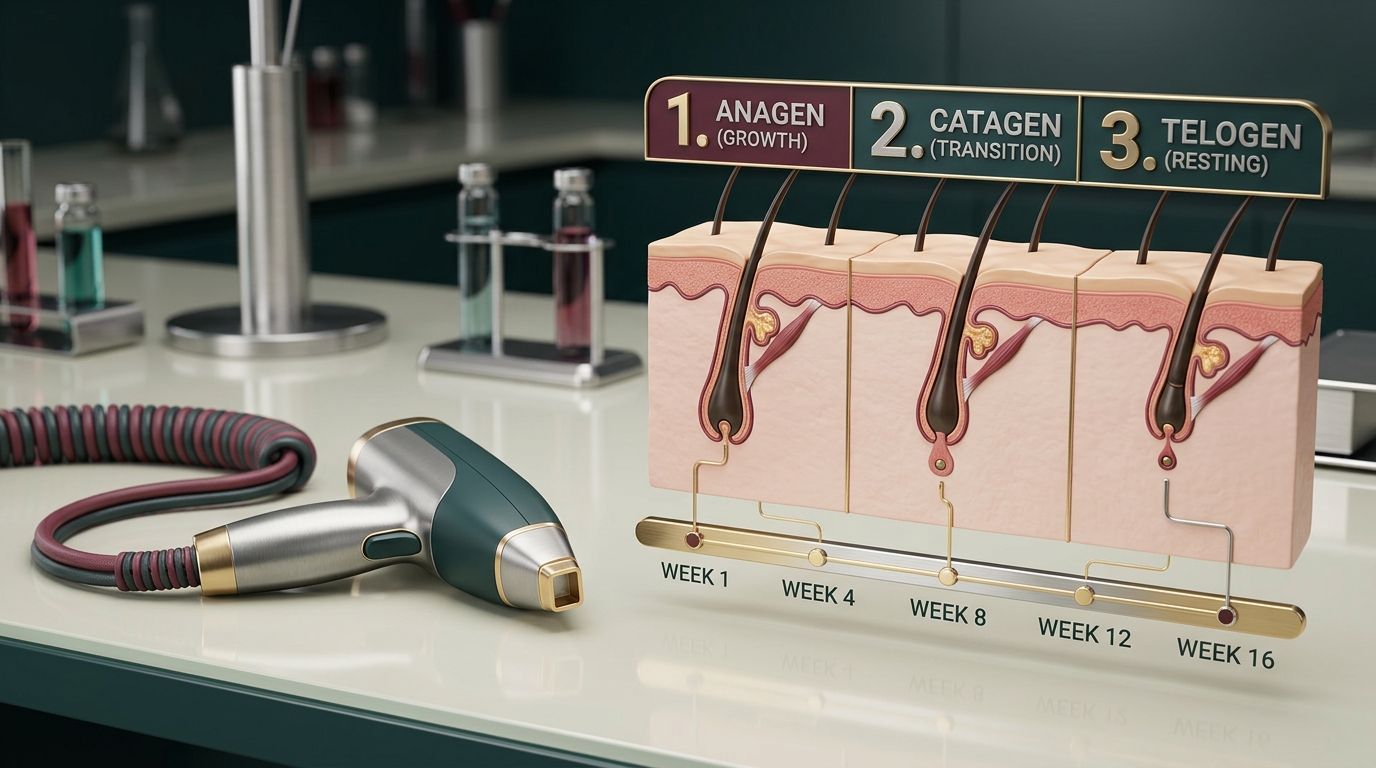
Growth diagrams are simplifications. Real cycles overlap, vary by anatomy and are influenced by age, hormones and individual biology. A calendar cannot identify follicle phase by itself. The clinician therefore combines a biologically plausible interval with visible regrowth and your prior response. This is the reason a responsible plan uses ranges and review points instead of claiming that a universal six-visit schedule will complete every face, underarm, bikini line, back or leg.
What determines how many sessions you may need?
| Variable | Why it changes the course |
|---|---|
| Body area | Facial hair often behaves differently from leg or underarm hair. Cycle length, follicle depth, density and hormonal sensitivity vary by site, so one person can follow different calendars for two areas. |
| Hair colour and calibre | Coarse, dark hair often provides a clearer optical target than very fine, light, red, grey or white hair. Low pigment can reduce the usefulness of standard laser approaches and should be discussed before buying a course. |
| Skin tone and recent sun exposure | Safe device choice and settings depend on the relationship between epidermal pigment and hair pigment. A tan, sunburn or pigment change can require delay or adjustment rather than pressing ahead on a package date. |
| Density and distribution | A dense starting field can need more staged reduction than a sparse area. Patchy or newly expanding growth may also signal that the practitioner should review the pattern rather than simply add sessions. |
| Hormonal and medical influences | Polycystic ovary syndrome, menopause, some medicines and other endocrine factors can affect hair growth. Laser can reduce visible hair without treating the underlying driver. New or rapid growth deserves medical review. |
| Device, wavelength and technique | Different systems interact with skin and hair in different ways. Operator training, cooling, spot overlap, fluence, pulse duration and conservative adjustment all influence safety and response. Brand name alone is not a treatment plan. |
| Attendance and timing | Repeatedly treating too early, missing long stretches or changing providers without records can make progress harder to interpret. A consistent, documented course supports better decisions. |
| Your definition of success | Some people want a major reduction in shaving; others expect near-total smoothness. The second goal is harder to sustain, and no ethical provider should promise permanent removal of every hair. |
The consultation should connect these variables rather than scoring them separately. For example, coarse underarm hair on untanned skin may respond differently from fine chin hair in the same person. Likewise, the number that worked for a friend with similar skin colour is not transferable if body area, hair calibre, medication, hormonal context or device parameters differ.
How far apart should laser hair removal sessions be?
A commonly discussed starting interval is several weeks. The AAD patient FAQ says treatment is often repeated every four to six weeks, yet that statement is intentionally general. Some facial schedules begin in that neighborhood because visible turnover can be faster, while large body areas may be reviewed at longer intervals as the course progresses. Your practitioner may lengthen the gap when regrowth becomes slower and sparser.
The right question is not “What is the shortest interval I can book?” but “Has a useful new wave of hair appeared, and is the skin ready?” Treating merely because a package calendar says so can expose the skin to another procedure without adding proportional value. Conversely, waiting indefinitely can make continuity and assessment difficult. A flexible appointment window—supported by photographs, notes and a check-in—works better than a rigid recurring date.
If the area is still smooth with minimal new growth at the planned date, contact the provider before attending. If there is unexpected dense regrowth, irritation, pigment change, a new medication or substantial tanning, contact them as well. A schedule is a clinical tool, not a contract that overrides current skin condition.
Body-area planning atlas: why calendars differ
The following area notes are planning aids, not prescribed intervals. They show why a single package calendar is too blunt. Actual timing must come from examination, treatment history and current regrowth.
Upper lip
Upper lip hair may show often quicker visible turnover. The practical complication is that small, hormonally responsive and easy to over-treat when fine hairs are mistaken for strong targets. A safe course therefore begins with a documented baseline: hair calibre and colour, skin condition, recent sun exposure, hair-removal method, medication and any previous laser or intense pulsed light treatment. This baseline helps the practitioner distinguish normal asynchronous return from a poor target, a settings issue or a changing medical pattern.
For scheduling, begin with a clinician-set several-week window, then review visible return. After each visit, note when shedding starts, when the area first looks quiet, when definite new growth becomes visible and whether that return is coarse, fine or patchy. Those observations support a more meaningful next date than automatically repeating the first interval. As reduction develops, the gap may be extended because treating a nearly hair-free field offers little additional target.
Practical advice: Do not compress appointments for a holiday; protect from sun and report pigment change. Ask the provider to explain the endpoint for this specific area: reduction in density, slower regrowth, less frequent shaving, or another realistic goal. If the hair becomes very fine, continuing indefinitely may not be useful. A review can be a successful decision even when it leads to pausing rather than adding appointments.
Chin and jawline
Chin and jawline hair may show variable turnover with possible hormonal influence. The practical complication is that density can change with endocrine factors, age or medication. A safe course therefore begins with a documented baseline: hair calibre and colour, skin condition, recent sun exposure, hair-removal method, medication and any previous laser or intense pulsed light treatment. This baseline helps the practitioner distinguish normal asynchronous return from a poor target, a settings issue or a changing medical pattern.
For scheduling, use progress photographs and reassess if new zones appear. After each visit, note when shedding starts, when the area first looks quiet, when definite new growth becomes visible and whether that return is coarse, fine or patchy. Those observations support a more meaningful next date than automatically repeating the first interval. As reduction develops, the gap may be extended because treating a nearly hair-free field offers little additional target.
Practical advice: Seek medical advice for sudden coarse growth or other hormonal symptoms. Ask the provider to explain the endpoint for this specific area: reduction in density, slower regrowth, less frequent shaving, or another realistic goal. If the hair becomes very fine, continuing indefinitely may not be useful. A review can be a successful decision even when it leads to pausing rather than adding appointments.
Underarms
Underarms hair may show often a clearer coarse-hair target. The practical complication is that friction, deodorant, irritation and recent tanning affect comfort and timing. A safe course therefore begins with a documented baseline: hair calibre and colour, skin condition, recent sun exposure, hair-removal method, medication and any previous laser or intense pulsed light treatment. This baseline helps the practitioner distinguish normal asynchronous return from a poor target, a settings issue or a changing medical pattern.
For scheduling, use a several-week interval and lengthen when return slows. After each visit, note when shedding starts, when the area first looks quiet, when definite new growth becomes visible and whether that return is coarse, fine or patchy. Those observations support a more meaningful next date than automatically repeating the first interval. As reduction develops, the gap may be extended because treating a nearly hair-free field offers little additional target.
Practical advice: Arrive with intact skin and follow the provider’s shaving guidance. Ask the provider to explain the endpoint for this specific area: reduction in density, slower regrowth, less frequent shaving, or another realistic goal. If the hair becomes very fine, continuing indefinitely may not be useful. A review can be a successful decision even when it leads to pausing rather than adding appointments.
Bikini line
Bikini line hair may show coarse hair but sensitive skin. The practical complication is that shape, density, friction and post-inflammatory pigment risk differ. A safe course therefore begins with a documented baseline: hair calibre and colour, skin condition, recent sun exposure, hair-removal method, medication and any previous laser or intense pulsed light treatment. This baseline helps the practitioner distinguish normal asynchronous return from a poor target, a settings issue or a changing medical pattern.
For scheduling, review after shedding and when a new cohort is visible. After each visit, note when shedding starts, when the area first looks quiet, when definite new growth becomes visible and whether that return is coarse, fine or patchy. Those observations support a more meaningful next date than automatically repeating the first interval. As reduction develops, the gap may be extended because treating a nearly hair-free field offers little additional target.
Practical advice: Clarify boundaries and consent before every treatment. Ask the provider to explain the endpoint for this specific area: reduction in density, slower regrowth, less frequent shaving, or another realistic goal. If the hair becomes very fine, continuing indefinitely may not be useful. A review can be a successful decision even when it leads to pausing rather than adding appointments.
Lower legs
Lower legs hair may show slower-feeling return over a large field. The practical complication is that large surface area, sun exposure and mixed density affect assessment. A safe course therefore begins with a documented baseline: hair calibre and colour, skin condition, recent sun exposure, hair-removal method, medication and any previous laser or intense pulsed light treatment. This baseline helps the practitioner distinguish normal asynchronous return from a poor target, a settings issue or a changing medical pattern.
For scheduling, body-area schedules may lengthen as reduction develops. After each visit, note when shedding starts, when the area first looks quiet, when definite new growth becomes visible and whether that return is coarse, fine or patchy. Those observations support a more meaningful next date than automatically repeating the first interval. As reduction develops, the gap may be extended because treating a nearly hair-free field offers little additional target.
Practical advice: Avoid treating tanned or sunburned skin and plan around beach travel. Ask the provider to explain the endpoint for this specific area: reduction in density, slower regrowth, less frequent shaving, or another realistic goal. If the hair becomes very fine, continuing indefinitely may not be useful. A review can be a successful decision even when it leads to pausing rather than adding appointments.
Thighs
Thighs hair may show often finer or more mixed than lower legs. The practical complication is that fine hair may be a poor target and can make endpoint expectations unrealistic. A safe course therefore begins with a documented baseline: hair calibre and colour, skin condition, recent sun exposure, hair-removal method, medication and any previous laser or intense pulsed light treatment. This baseline helps the practitioner distinguish normal asynchronous return from a poor target, a settings issue or a changing medical pattern.
For scheduling, assess hair calibre carefully before committing to a long course. After each visit, note when shedding starts, when the area first looks quiet, when definite new growth becomes visible and whether that return is coarse, fine or patchy. Those observations support a more meaningful next date than automatically repeating the first interval. As reduction develops, the gap may be extended because treating a nearly hair-free field offers little additional target.
Practical advice: Do not assume the thigh will mirror lower-leg response. Ask the provider to explain the endpoint for this specific area: reduction in density, slower regrowth, less frequent shaving, or another realistic goal. If the hair becomes very fine, continuing indefinitely may not be useful. A review can be a successful decision even when it leads to pausing rather than adding appointments.
Forearms
Forearms hair may show frequently sun exposed with mixed hair calibre. The practical complication is that contrast can change seasonally and treatment borders can look obvious. A safe course therefore begins with a documented baseline: hair calibre and colour, skin condition, recent sun exposure, hair-removal method, medication and any previous laser or intense pulsed light treatment. This baseline helps the practitioner distinguish normal asynchronous return from a poor target, a settings issue or a changing medical pattern.
For scheduling, use conservative mapping and seasonal review. After each visit, note when shedding starts, when the area first looks quiet, when definite new growth becomes visible and whether that return is coarse, fine or patchy. Those observations support a more meaningful next date than automatically repeating the first interval. As reduction develops, the gap may be extended because treating a nearly hair-free field offers little additional target.
Practical advice: Ask how the provider blends boundaries rather than chasing every fine hair. Ask the provider to explain the endpoint for this specific area: reduction in density, slower regrowth, less frequent shaving, or another realistic goal. If the hair becomes very fine, continuing indefinitely may not be useful. A review can be a successful decision even when it leads to pausing rather than adding appointments.
Upper arms
Upper arms hair may show fine hair is common. The practical complication is that low-contrast or downy hair can be unsuitable for conventional laser reduction. A safe course therefore begins with a documented baseline: hair calibre and colour, skin condition, recent sun exposure, hair-removal method, medication and any previous laser or intense pulsed light treatment. This baseline helps the practitioner distinguish normal asynchronous return from a poor target, a settings issue or a changing medical pattern.
For scheduling, obtain a candid suitability assessment first. After each visit, note when shedding starts, when the area first looks quiet, when definite new growth becomes visible and whether that return is coarse, fine or patchy. Those observations support a more meaningful next date than automatically repeating the first interval. As reduction develops, the gap may be extended because treating a nearly hair-free field offers little additional target.
Practical advice: Decline fixed-course promises when the target is weak. Ask the provider to explain the endpoint for this specific area: reduction in density, slower regrowth, less frequent shaving, or another realistic goal. If the hair becomes very fine, continuing indefinitely may not be useful. A review can be a successful decision even when it leads to pausing rather than adding appointments.
Chest
Chest hair may show density and pattern vary widely. The practical complication is that coarse central hair and finer margins may need different expectations. A safe course therefore begins with a documented baseline: hair calibre and colour, skin condition, recent sun exposure, hair-removal method, medication and any previous laser or intense pulsed light treatment. This baseline helps the practitioner distinguish normal asynchronous return from a poor target, a settings issue or a changing medical pattern.
For scheduling, map the field and reassess margins as density falls. After each visit, note when shedding starts, when the area first looks quiet, when definite new growth becomes visible and whether that return is coarse, fine or patchy. Those observations support a more meaningful next date than automatically repeating the first interval. As reduction develops, the gap may be extended because treating a nearly hair-free field offers little additional target.
Practical advice: Avoid sharp untreated borders by agreeing the design. Ask the provider to explain the endpoint for this specific area: reduction in density, slower regrowth, less frequent shaving, or another realistic goal. If the hair becomes very fine, continuing indefinitely may not be useful. A review can be a successful decision even when it leads to pausing rather than adding appointments.
Back and shoulders
Back and shoulders hair may show large area with asynchronous and sometimes hormonally influenced growth. The practical complication is that coverage, overlap, comfort and border design matter. A safe course therefore begins with a documented baseline: hair calibre and colour, skin condition, recent sun exposure, hair-removal method, medication and any previous laser or intense pulsed light treatment. This baseline helps the practitioner distinguish normal asynchronous return from a poor target, a settings issue or a changing medical pattern.
For scheduling, use documented mapping and potentially longer body-area gaps. After each visit, note when shedding starts, when the area first looks quiet, when definite new growth becomes visible and whether that return is coarse, fine or patchy. Those observations support a more meaningful next date than automatically repeating the first interval. As reduction develops, the gap may be extended because treating a nearly hair-free field offers little additional target.
Practical advice: Budget time for full coverage rather than rushing a large field. Ask the provider to explain the endpoint for this specific area: reduction in density, slower regrowth, less frequent shaving, or another realistic goal. If the hair becomes very fine, continuing indefinitely may not be useful. A review can be a successful decision even when it leads to pausing rather than adding appointments.
Abdomen
Abdomen hair may show mixed calibre and hormonally influenced patterns can coexist. The practical complication is that a narrow line may differ from diffuse fine hair. A safe course therefore begins with a documented baseline: hair calibre and colour, skin condition, recent sun exposure, hair-removal method, medication and any previous laser or intense pulsed light treatment. This baseline helps the practitioner distinguish normal asynchronous return from a poor target, a settings issue or a changing medical pattern.
For scheduling, treat only suitable targets and reassess any spreading pattern. After each visit, note when shedding starts, when the area first looks quiet, when definite new growth becomes visible and whether that return is coarse, fine or patchy. Those observations support a more meaningful next date than automatically repeating the first interval. As reduction develops, the gap may be extended because treating a nearly hair-free field offers little additional target.
Practical advice: Ask whether observation or another method is better for fine hairs. Ask the provider to explain the endpoint for this specific area: reduction in density, slower regrowth, less frequent shaving, or another realistic goal. If the hair becomes very fine, continuing indefinitely may not be useful. A review can be a successful decision even when it leads to pausing rather than adding appointments.
Hands, feet and digits
Hands, feet and digits hair may show small areas with bony contours. The practical complication is that coverage and skin sensitivity require careful technique. A safe course therefore begins with a documented baseline: hair calibre and colour, skin condition, recent sun exposure, hair-removal method, medication and any previous laser or intense pulsed light treatment. This baseline helps the practitioner distinguish normal asynchronous return from a poor target, a settings issue or a changing medical pattern.
For scheduling, schedule with the parent limb only when regrowth supports it. After each visit, note when shedding starts, when the area first looks quiet, when definite new growth becomes visible and whether that return is coarse, fine or patchy. Those observations support a more meaningful next date than automatically repeating the first interval. As reduction develops, the gap may be extended because treating a nearly hair-free field offers little additional target.
Practical advice: Confirm eye protection and positioning despite the short treatment time. Ask the provider to explain the endpoint for this specific area: reduction in density, slower regrowth, less frequent shaving, or another realistic goal. If the hair becomes very fine, continuing indefinitely may not be useful. A review can be a successful decision even when it leads to pausing rather than adding appointments.
A realistic course timeline from consultation to maintenance
- Consultation and baseline. Review medical history, medicines, skin and hair characteristics, recent tanning, prior methods and expectations. Discuss alternatives and whether laser is appropriate. Photograph only with informed consent and explain how records are protected.
- Test and first treatment decision. When clinically indicated, a test area can help assess skin response and settings. It does not guarantee how an entire course will behave. The practitioner selects a device and parameters rather than copying a friend’s treatment.
- Early course. Appointments are commonly kept within a repeatable several-week framework. The goal is to observe shedding and encounter new growth cohorts while protecting the skin. Early improvement should not be converted into a guaranteed final count.
- Mid-course review. Compare the same area under similar lighting. Look for slower return, lower density, finer calibre and reduced shaving. If there is little change, check timing, target suitability, settings, adherence and possible medical influences.
- Late-course spacing. When regrowth becomes sparse, intervals often lengthen. Continuing at the original frequency just to finish prepaid visits may be wasteful. The course should follow biology, not package expiry pressure.
- Maintenance or discharge. Some people request occasional treatment when meaningful coarse regrowth returns; others stop and use another method for a few residual hairs. Maintenance is not evidence that the course failed, but it should not become an automatic subscription without visible indication.
Preparation matters at every stage. Follow the clinician’s instructions about shaving and avoid waxing, plucking or electrolysis when those methods would remove the target from the follicle. Share medication changes and protect the area from sun. The American Academy of Dermatology preparation guidance describes consultation, sun protection and avoiding certain hair-removal methods as important preparation themes; our local pre-treatment preparation guide translates those principles into a practical checklist.
How to judge whether your course is working
Do not judge progress only by how the skin looks on day two. Treated hairs may remain visible before releasing, and apparent immediate “growth” can be hair shafts moving outward. A useful record tracks the full interval: shedding, the quiet period, the date of definite new growth, how often you shave and whether the returning hairs are as coarse and dense as before.
Standardised photographs can help when they use the same angle, distance, lighting and hair length. Numbers can help too: shaving frequency per week, days until clear regrowth and the proportion of the area that remains quiet. These measures are imperfect, but they reduce reliance on memory. Never use social-media before-and-after images from another person as your benchmark.
A review is warranted when there is no discernible change after properly timed sessions, when the pattern expands, when hairs become too fine to target, or when adverse effects occur. The answer may be to alter timing or settings, investigate an underlying influence, change method, or stop. “More sessions” is not the only response.
When the interval may need to be longer
Longer spacing can make sense when regrowth is sparse, when a body area turns over slowly, when the skin has not fully recovered, or when sun exposure makes treatment unsafe. It may also be necessary after a medication change, illness, pregnancy-related decision, pigment change or another procedure in the same area. These are not lost weeks; they are reasons to re-establish a safe baseline.
A longer interval does not erase previous reduction. Hair biology continues, and some follicles may become treatable later. The main disadvantage of a very long unsupervised break is that records and visual comparison become less useful. If you must pause for travel or health reasons, ask the clinic to document the stage reached and what conditions should be met before restarting.
People planning summer in Istanbul should consider sun exposure early. Legs, arms, face and shoulders may tan even during ordinary walking, commuting or Bosphorus trips. Daily broad-spectrum sun protection, clothing and candid reporting matter more than keeping a prepaid date. Never conceal tanning to avoid rescheduling.
When the interval should not be shortened
A short city visit, a wedding, an expiring package or impatience does not change the growth cycle. Adding appointments close together cannot force resting follicles into active growth. It can, however, increase cost and expose skin that may not have enough useful target hair. A provider should be willing to say that another session is premature.
Do not treat persistent redness, blistering, crusting, marked tenderness or pigment change as a scheduling inconvenience. Contact the provider promptly and obtain medical care when appropriate. The next appointment should not proceed until the reaction is assessed. Photographs and a clear timeline can help the clinician understand what happened.
Likewise, do not shorten the interval because shaving makes hair feel blunt. Shaving cuts the shaft at the surface; it does not create more follicles or accelerate their cycle. The visible stubble may feel coarser because of the cut edge, but that sensation is not proof that the course has reversed.
Istanbul planning: residents, frequent visitors and short trips
Fatih resident with a regular workweek
Choose a realistic appointment window and keep a simple response diary. Local flexibility makes it easier to delay for tanning, irritation or insufficient regrowth without compressing the next visit. The key is to separate travel logistics from treatment biology. A date is suitable only when the skin is safe to treat, the area has meaningful target regrowth and the practitioner considers the timing appropriate.
Before confirming, share recent sun exposure, new medicines, reactions and any hair removal since the previous visit. Arrange post-treatment sun avoidance and contact instructions. If these conditions cannot be met, convert the trip into a consultation or postpone rather than forcing a session into the calendar.
Student with changing class times
Book within the clinician’s window rather than on one exact recurring weekday. Keep examinations and travel in view, and avoid starting just before a long sun holiday. The key is to separate travel logistics from treatment biology. A date is suitable only when the skin is safe to treat, the area has meaningful target regrowth and the practitioner considers the timing appropriate.
Before confirming, share recent sun exposure, new medicines, reactions and any hair removal since the previous visit. Arrange post-treatment sun avoidance and contact instructions. If these conditions cannot be met, convert the trip into a consultation or postpone rather than forcing a session into the calendar.
Professional traveling between cities
Ask for a written treatment summary with area, date, device class and skin response. Continuity matters if another qualified provider must assess the next session. The key is to separate travel logistics from treatment biology. A date is suitable only when the skin is safe to treat, the area has meaningful target regrowth and the practitioner considers the timing appropriate.
Before confirming, share recent sun exposure, new medicines, reactions and any hair removal since the previous visit. Arrange post-treatment sun avoidance and contact instructions. If these conditions cannot be met, convert the trip into a consultation or postpone rather than forcing a session into the calendar.
Visitor in Istanbul for one week
Use the visit for consultation or one appropriately timed session only if eligible. Do not attempt to stack a biological course into several days. Plan aftercare and a route for help after departure. The key is to separate travel logistics from treatment biology. A date is suitable only when the skin is safe to treat, the area has meaningful target regrowth and the practitioner considers the timing appropriate.
Before confirming, share recent sun exposure, new medicines, reactions and any hair removal since the previous visit. Arrange post-treatment sun avoidance and contact instructions. If these conditions cannot be met, convert the trip into a consultation or postpone rather than forcing a session into the calendar.
Expat returning every few months
A body-area schedule may sometimes align with trips, but facial or rapidly changing patterns may not. Let response determine whether travel cadence is workable. The key is to separate travel logistics from treatment biology. A date is suitable only when the skin is safe to treat, the area has meaningful target regrowth and the practitioner considers the timing appropriate.
Before confirming, share recent sun exposure, new medicines, reactions and any hair removal since the previous visit. Arrange post-treatment sun avoidance and contact instructions. If these conditions cannot be met, convert the trip into a consultation or postpone rather than forcing a session into the calendar.
Summer visitor planning beach days
Sun exposure can conflict with safe treatment. Prioritise skin condition and provider advice over itinerary convenience; a postponed session is preferable to hiding a tan. The key is to separate travel logistics from treatment biology. A date is suitable only when the skin is safe to treat, the area has meaningful target regrowth and the practitioner considers the timing appropriate.
Before confirming, share recent sun exposure, new medicines, reactions and any hair removal since the previous visit. Arrange post-treatment sun avoidance and contact instructions. If these conditions cannot be met, convert the trip into a consultation or postpone rather than forcing a session into the calendar.
Person comparing prepaid packages
Compare assessment quality, cancellation rules, unused-session policy, review points and maintenance terms. Do not compare only the headline number of visits. The key is to separate travel logistics from treatment biology. A date is suitable only when the skin is safe to treat, the area has meaningful target regrowth and the practitioner considers the timing appropriate.
Before confirming, share recent sun exposure, new medicines, reactions and any hair removal since the previous visit. Arrange post-treatment sun avoidance and contact instructions. If these conditions cannot be met, convert the trip into a consultation or postpone rather than forcing a session into the calendar.
Client moving abroad mid-course
Request records and clear consented photographs. A new provider should reassess rather than blindly continue another clinic’s settings or calendar. The key is to separate travel logistics from treatment biology. A date is suitable only when the skin is safe to treat, the area has meaningful target regrowth and the practitioner considers the timing appropriate.
Before confirming, share recent sun exposure, new medicines, reactions and any hair removal since the previous visit. Arrange post-treatment sun avoidance and contact instructions. If these conditions cannot be met, convert the trip into a consultation or postpone rather than forcing a session into the calendar.
Package maths: how to compare offers without buying a promise
A package is a payment structure, not biological evidence. Ten included visits do not prove that ten will be necessary, while a six-session offer does not prove that six will be sufficient. Ask whether the provider reassesses the area, whether timing can be changed without penalty, what happens when the target becomes too fine, and whether unused visits are transferable, refundable or convertible under written terms.
Request an itemised quotation stating the exact area boundaries, consultation or test fees, each session price, package validity, cancellation policy and maintenance pricing. Clarify whether tax is included and whether promotional conditions alter clinical scheduling. A cheap session that is mistimed, rushed or unsuitable can be poor value; a more expensive session is not automatically safer or more effective.
Be cautious with “unlimited,” “lifetime,” “pain-free,” “100 percent permanent” and “guaranteed in X sessions.” These phrases flatten important differences and may obscure exclusions. A better promise is procedural: qualified assessment, informed consent, eye protection, documented settings, clear aftercare, honest review and referral when the pattern needs medical attention.
Myths vs facts about session count and spacing
| Claim | Reality |
|---|---|
| Myth: everyone finishes in six sessions | Fact: public guidance may quote common ranges, but anatomy, hair, skin, health and response vary. Six can be a review point, not a universal finish line. |
| Myth: appointments closer together work faster | Fact: shorter gaps cannot force resting follicles into a responsive phase. Timing should follow regrowth and skin readiness. |
| Myth: more pain means a more effective session | Fact: pain is not a reliable dose meter. Safe parameters, cooling, target response and clinical judgment matter; unexpected pain should be reported. |
| Myth: shedding means every follicle is permanently gone | Fact: shedding is an expected short-term event, but later growth can come from other follicles or incompletely disabled targets. |
| Myth: shaving makes hair grow back thicker | Fact: shaving changes the blunt edge of the visible shaft, not the number of follicles or the biological cycle. |
| Myth: maintenance proves the original treatment failed | Fact: meaningful reduction can coexist with later regrowth or new hormonally influenced hair. Maintenance should be based on visible need, not automatic dates. |
| Myth: the same interval fits face and legs | Fact: body areas differ in cycling, density and hormonal sensitivity. One person may need separate calendars. |
| Myth: light, grey or white hair needs only more sessions | Fact: low pigment may make conventional laser targeting ineffective. Suitability should be assessed rather than selling an extended package. |
| Myth: a device brand decides the exact number | Fact: wavelength and system capabilities matter, but operator assessment, settings, skin condition, hair target and timing also shape results. |
| Myth: travel plans justify back-to-back sessions | Fact: biology cannot be compressed into a holiday. A short Istanbul visit may support consultation or one properly timed treatment, not an entire course. |
| Myth: no visible hair means the course is permanently complete | Fact: a quiet interval is encouraging, but later cohorts or hormonally driven hairs may emerge. Follow-up should remain evidence based. |
| Myth: every residual hair should be chased with laser | Fact: when remaining hairs are very fine or sparse, another method or simple observation may be safer and more proportionate. |
Safety and medical boundaries
Laser hair reduction is a procedure with real contraindications and side effects. A consultation should cover medicines, photosensitivity, skin conditions, scarring history, infections, pregnancy-related policy, recent procedures and sun exposure. Common temporary effects can include redness and swelling around follicles, while burns, blistering, pigment change or scarring require prompt attention. Eye protection appropriate to the wavelength is essential for everyone in the room.
New, sudden or rapidly increasing hair growth can be a health clue, especially when accompanied by menstrual changes, acne, scalp hair loss, voice change or other symptoms. A beauty appointment is not a substitute for medical evaluation. The practitioner should know when to pause and refer. Laser may reduce visible hair but does not diagnose or treat an endocrine cause.
This article deliberately avoids naming an unverified device, doctor, protocol or approval status at Nexja. Suitability and equipment details should be confirmed directly at consultation. Current general safety questions can be reviewed in the American Academy of Dermatology laser hair removal FAQ; source information supports discussion but cannot replace the practitioner who examines your skin.
A consultation checklist for a defensible schedule
- Which hair and skin features make this area a reasonable target?
- What initial interval range do you recommend, and what evidence will make you lengthen or shorten it?
- Who performs the procedure, and what training and supervision apply?
- What device class and wavelength are planned, and why are they suitable for my skin and hair?
- What are the realistic reduction goals, and what cannot be promised?
- How will you document settings, response and adverse events?
- What should I do about shaving, waxing, plucking, creams and sun exposure?
- Which medicines, conditions or recent treatments require delay or medical clearance?
- What happens if the area shows little change after several properly timed visits?
- How do package expiry, cancellation and unused-session rules interact with clinical rescheduling?
- When would you stop because the remaining hair is too fine or the risk-benefit balance has changed?
- What aftercare and urgent-contact route are available if I react after leaving Istanbul?
Bring a medication list and a clear history of previous hair-removal methods. Avoid withholding information to secure treatment on a preferred date. A provider who postpones because the area is tanned, irritated or lacks useful regrowth is protecting the course, not failing to deliver it.
Frequently asked questions
How many laser hair removal sessions do most people need?
Many people need several sessions. The AAD notes a common range of two to six treatments, but real courses can be shorter or longer depending on the area, hair and skin characteristics, health influences, device and response. Treat that range as educational, not a promise. The correct number is revised after documented progress.
Is six sessions enough for permanent results?
Six may be enough to produce a meaningful reduction for some people and areas, but it is not a guaranteed permanent endpoint. Some follicles are not responsive on each date, some hairs are poor optical targets, and new growth can appear later. Ask for a six-session review rather than a guarantee.
Can I have laser hair removal every two weeks?
Usually, a fixed two-week rhythm is too short for many areas, but only your treating practitioner can decide. The question is whether useful new target hair has emerged and whether the skin has recovered. Do not compress sessions merely to finish before travel or an event.
Why are facial sessions often closer together than leg sessions?
Facial hair can show visible return sooner and may be more hormonally influenced, while leg hair often appears to cycle more slowly. These are broad tendencies, not rules. Your actual interval should respond to the treated zone, calibre, shedding and new growth.
What happens if I miss a session?
A missed appointment does not normally erase previous reduction. Contact the provider, explain the gap and allow the area to be reassessed. Do not compensate with back-to-back visits. The next date should be based on regrowth, skin condition and sun exposure.
What happens if I book too early?
There may be too little actively growing target hair to justify treatment. The session could add cost and skin exposure without proportional benefit. A good provider may postpone after examining the area. Package rules should allow clinically sensible rescheduling.
Can I wait too long between sessions?
A long pause can make the course slower and records less comparable, but it does not mean every previous effect disappears. When restarting, obtain a fresh assessment rather than assuming the old settings and timing still apply.
When should session intervals become longer?
Intervals often lengthen when regrowth takes longer, density falls and only a small new cohort appears. They may also lengthen for safety after tanning, irritation, illness or medication changes. The decision should be documented rather than automatic.
How do I know a session worked?
Look across the full interval for shedding, a longer hair-free period, reduced density, finer return and less frequent shaving. Immediate smoothness alone is not proof. Consistent photographs and a simple shave-frequency diary can make reviews more objective.
Why does hair seem to grow after treatment?
Treated shafts can remain in the skin and move outward before releasing, which can resemble continued growth. Other follicles can also enter an active phase later. Follow the aftercare instructions and avoid plucking so the provider can interpret the pattern.
Should I wax between sessions?
Waxing and plucking remove hair from the follicle and can remove the intended target before a later session. Many providers advise shaving instead, but follow your clinic’s specific instructions and timing. Do not improvise if the skin is irritated.
Does shaving increase the number of sessions?
Shaving does not create new follicles or make the biological cycle faster. It cuts hair at the surface and is commonly used between appointments when advised. The blunt edge may feel rougher, which can be mistaken for thicker growth.
Do darker hairs need fewer sessions?
Dark, coarse hair can be a clearer optical target, but session count still depends on body area, density, skin tone, settings and biology. Strong contrast may support response; it does not justify a guaranteed number.
Can blonde, red, grey or white hair be treated?
Low-pigment hair may respond poorly to conventional pigment-targeting lasers. More sessions do not necessarily solve an unsuitable target. Ask for a candid assessment and alternatives rather than accepting a long prepaid course.
Does darker skin always need more sessions?
Skin tone alone does not determine a count. It does affect device and parameter selection because epidermal pigment must be protected. An experienced practitioner should explain the safety approach and realistic response without stereotyping outcomes.
Can hormonal hair growth be permanently stopped?
Laser can reduce suitable visible hairs but cannot remove an underlying hormonal driver. Facial or newly spreading hair may need medical assessment and can require ongoing management. Avoid any provider who promises to cure a hormonal condition with laser.
What is a maintenance session?
Maintenance is an occasional treatment considered when meaningful suitable regrowth returns after the main course. It should be triggered by observed need, not an automatic monthly subscription. A few fine residual hairs may be better managed another way.
How often is maintenance needed?
There is no universal interval. Some people seek an occasional review; others need none for long periods. Body area, hormones, age and residual target quality matter. Book after assessment when there is enough suitable regrowth.
Can I complete a course during a short Istanbul trip?
No short trip can compress months of asynchronous growth into days. A visitor may be able to have a consultation or one properly timed session if eligible. Plan continuity, records, sun precautions and aftercare support before leaving.
Is winter the best time to start?
Winter can make sun avoidance easier for exposed areas, but it is not automatically the only safe season. Your habits, travel, tanning and skin condition matter. Starting when you can maintain sun protection and regular reviews is more important than a calendar label.
Can I treat two body areas on the same schedule?
Sometimes, but not automatically. Areas can show different regrowth and may need separate intervals. Ask the practitioner to review each zone independently rather than keeping them synchronized for convenience.
Should I continue until every hair is gone?
Not necessarily. Laser hair removal is better described as long-term reduction, and the last fine or light hairs can be poor targets. Continuing indefinitely may offer diminishing benefit. Agree on a stopping rule before the package begins.
Why is my regrowth patchy?
Patchiness can reflect asynchronous cycles, uneven starting density, treatment coverage or variable response. It should be mapped and reviewed rather than hidden by rushed touch-ups. Do not assume every patch requires an immediate extra session.
Can device settings stay the same for every visit?
Settings may be adjusted according to skin response, hair changes, tanning and the device’s protocol. More energy is not always better. Only a qualified practitioner should make changes, with safety and documentation taking priority.
What if I see no reduction after several sessions?
Request a structured review. Check target suitability, intervals, settings, adherence, documentation and possible medical influences. The answer may be a changed plan, another method, referral or stopping—not simply purchasing more visits.
Can I change clinics during a course?
Yes, but the new provider should reassess you. Request dates, treated areas, device details when available, reactions and consented progress records. A responsible new clinic will not blindly copy settings from another system.
How should I compare laser packages in Istanbul?
Compare assessment, practitioner qualifications, area definitions, documentation, rescheduling, unused-session rules, adverse-event support and maintenance terms. Do not rank packages only by visit count or discount. Biology does not become more predictable because sessions are prepaid.
Is laser hair removal completely pain-free?
Comfort varies by area, person, device and cooling. “Pain-free” should not be guaranteed. Report sharp, escalating or unexpected discomfort immediately; pain is not proof that treatment is working.
When should I seek medical advice about hair growth?
Seek medical advice for sudden, rapidly increasing or newly distributed coarse hair, especially with menstrual change, acne, scalp hair loss, voice change or other symptoms. A laser appointment cannot diagnose the cause.
What should I do before my first appointment?
Arrange a consultation, disclose health and medication information, avoid tanning, and follow instructions about plucking, waxing and shaving. The American Academy of Dermatology preparation guidance and our pre-treatment preparation guide provide useful questions, but your clinic’s personalised instructions take precedence.
A decision pathway when the schedule no longer fits
If there is almost no regrowth at the booked date
Contact the clinic before travelling. Describe the treated area, the date of the last session, shedding, current hair visibility and any skin change. If possible, send a consented photograph taken in neutral light. The practitioner may recommend waiting until a clearer cohort appears. Postponement can protect both value and skin because a nearly empty field offers little pigment target.
Do not create artificial visibility by plucking, waxing or repeatedly shaving immediately before the assessment. The clinic needs an honest picture of return. If a prepaid package has a short expiry, ask for written confirmation that clinically justified delay will not force an unnecessary visit. Commercial terms should not override professional judgment.
If regrowth is dense and early
Dense early return does not automatically prove failure. Some shafts may be releasing, the interval may have captured a different cohort, or the starting density may make early changes hard to see. Compare like with like: same number of days after treatment, same lighting and similar hair length. Ask the practitioner to review coverage, settings, target response and whether the apparent hair is coarse new growth or retained treated shaft.
If the pattern is genuinely unchanged over several properly timed sessions, a formal review is more useful than accelerating appointments. The provider should reconsider target suitability, device choice, conservative parameters, attendance, recent tanning and possible medical influences. A decision to refer or stop is preferable to an indefinite series with no objective benefit.
If regrowth appears in a new area
Expansion beyond the original map deserves separate assessment. It may reflect ordinary observation, changing grooming, age, hormones, medicine or another factor; the cause cannot be diagnosed from an image or an online article. Do not simply widen the treatment field and assume the same package applies. Record when the change began and any associated symptoms.
A qualified clinician can decide whether the new hair is a reasonable optical target and whether medical advice is appropriate. Very fine surrounding hair should not be swept into treatment merely to make boundaries larger. Consent should be renewed whenever the treated area changes.
If the skin reacts more strongly than before
Stop routine scheduling and contact the treating provider. Record when symptoms began, how they evolved and which products, medicines or sun exposure occurred around the appointment. Seek urgent medical care for severe pain, extensive blistering, signs of infection, eye symptoms or other concerning features. Do not apply unapproved remedies or cover a serious reaction simply to keep a future session.
Before any restart, the practitioner should reassess skin recovery and the likely cause. The plan may require a longer delay, different parameters, a test area, another method or medical review. Previous tolerance does not guarantee future tolerance because skin condition, tanning and medicines can change.
How to keep a useful treatment record
A simple record makes session spacing safer and more transparent. For every area, note the appointment date, whether the skin was recently exposed to sun, the hair-removal method used beforehand, and any new medicine or health change. The provider should retain its own technical record; your personal log complements it and helps when travel or a clinic change interrupts the course.
| Record item | What to capture | Why it helps |
|---|---|---|
| Baseline | Area boundaries, hair colour and calibre, usual shaving frequency, neutral-light photograph with consent | Defines what improvement is being compared against |
| Treatment day | Date, treated area, practitioner, immediate skin response and aftercare supplied | Creates continuity without asking the client to interpret technical settings |
| Days 1–7 | Redness, swelling, tenderness, products used and sun exposure | Identifies recovery patterns and reactions that need contact |
| Shedding window | When treated shafts begin to release and when the area looks quiet | Separates expected release from convincing new growth |
| Return | First date of definite new hair, its density, calibre and distribution | Supports the next interval rather than relying on a fixed calendar |
| Grooming | Shaving dates and any accidental waxing or plucking | Explains why visible target hair or comparisons may differ |
| Review decision | Keep, lengthen, shorten, pause, refer or stop, with the reason | Shows that scheduling follows evidence instead of package pressure |
Keep photographs private and store only what you need. A clinic should explain consent, access and retention if it takes images. Progress photography is optional evidence, not marketing permission. Before-and-after use on a website or social channel needs separate, specific consent; treatment consent alone is not enough.
Aftercare across the interval
Immediately after treatment
Follow the provider’s cooling and product instructions. Temporary redness or swelling around follicles can occur, but intensity and duration vary. Avoid rubbing, picking and unapproved active products. Confirm the contact route before leaving, particularly if you are visiting Istanbul and will travel soon. Eye symptoms, severe pain, extensive blistering or rapidly worsening change require urgent assessment.
During the first days
Use gentle care and sun protection as advised. Heat, friction, intense exercise, hot bathing, swimming or fragranced products may be restricted for a period depending on the area and your response; follow the individual aftercare sheet rather than a generic timetable. Take a neutral photograph if an unusual reaction develops, then contact the provider instead of waiting for the next appointment.
During shedding and the quiet phase
Let hairs release naturally. Do not pull them to test whether treatment worked. Shave only when the provider says the skin is ready. The quiet phase is part of the observation period: note how long it lasts and resist booking early simply because the calendar has an opening.
As new growth becomes visible
Distinguish scattered fine hairs from a meaningful coarse cohort. A few visible hairs may not justify treating the entire area. Share the pattern with the clinic and schedule inside the window they recommend. If the return is materially different from the starting pattern, request a review rather than assuming the next standard session will answer every issue.
What the evidence can and cannot tell you
Professional patient guidance is valuable for broad expectations: multiple treatments are typical, sessions are separated by weeks, active-growth hairs are useful targets, results vary and maintenance may be needed. It also supports familiar safety themes such as consultation, sun protection and avoiding hair-removal methods that remove the follicular target. These points justify a staged, documented course.
Evidence is less able to predict one person’s exact count. Studies can use different devices, wavelengths, body sites, follow-up periods, skin classifications and outcome definitions. “Hair reduction” may be measured at different times, and a percentage does not tell a reader whether the remaining hair is coarse, fine, bothersome or easy to manage. Clinic marketing often removes this context.
That limitation should change how numbers are communicated. Use a range only with its conditions, say when it comes from general guidance rather than a Nexja result, and avoid converting population averages into an individual promise. Reassessment is not uncertainty to hide; it is the mechanism that makes a plan responsive and safer.
This article therefore does not publish a proprietary Nexja protocol, device model, price, approval claim, physician name or outcome statistic that has not been verified. It uses established public guidance for general education and directs individual decisions back to assessment. Readers should check source pages for updates and ask the treating professional how current evidence applies to them.
How to recognise a high-quality review appointment
A review should look at the treated area rather than functioning as a sales conversation. The practitioner compares the baseline with current density and calibre, asks about shaving frequency and the timeline of return, checks for pigment or texture change, and confirms sun exposure, medicine and health updates. If photographs exist, they should be viewed under comparable conditions.
The outcome may be to keep the interval, lengthen it, postpone, change parameters within the device protocol, treat a smaller field, investigate a health influence, use another removal method or stop. A high-quality review can therefore result in no laser that day. The value lies in the decision, not only in firing the device.
Ask the reviewer to state the next measurable goal. Examples include a longer gap before coarse regrowth, lower shave frequency, fewer dense patches or a decision point after two more properly timed visits. “Continue until complete” is not measurable. A defined goal makes cost and benefit easier to reassess.
A concise planning example—without pretending it is your prescription
Imagine a resident starting suitable coarse underarm hair treatment after consultation. The clinic documents the baseline and proposes an initial several-week window. After the first visit, the client records short-lived redness, later shedding and the date a clear new cohort appears. The second visit is booked inside the recommended window because the skin is calm and useful regrowth is present.
By the middle of the course, the client shaves less often and return is patchier. Instead of preserving the first interval forever, the practitioner lengthens the gap. At a later review, only sparse fine hairs remain. The clinician explains that another full-area session may offer little value and discusses observation or another approach for isolated hairs. Maintenance is left as an option if meaningful coarse return occurs.
Now imagine facial growth with a changing hormonal pattern. Even if appointments initially fit a similar several-week window, new distribution or persistent coarse return triggers medical review and a revised long-term expectation. These examples show why “six sessions, every month” is not a complete plan: the observations between dates are what make the calendar defensible.
The practical bottom line
There is no single honest answer to “how many laser hair removal sessions do I need?” Several treatments are usually required because hair grows asynchronously, but the number and spacing must be revised according to body area, visible regrowth, skin readiness and documented response. Common public ranges can orient you; they cannot predict an individual finish line.
Build the course around review points. Start with a qualified assessment, record the baseline, prepare correctly, protect the skin from sun, allow time for a new growth cohort, and lengthen intervals when return slows. Stop or change direction when the target becomes unsuitable, progress is absent, adverse effects occur or a medical pattern needs investigation.
For a personalised discussion in Fatih, Istanbul, review the laser hair removal service in Fatih. Continue learning through the Laser Hair Removal Guide archive. Any appointment should follow direct assessment and informed consent; nothing in this guide is a diagnosis, a guaranteed result, or a substitute for medical care.
