

Laser vs IPL vs “Ice Laser”: What These Terms Mean Before You Book
A safety-led comparison of laser hair removal, IPL and “ice laser” terminology, with practical questions for choosing treatment in Istanbul.
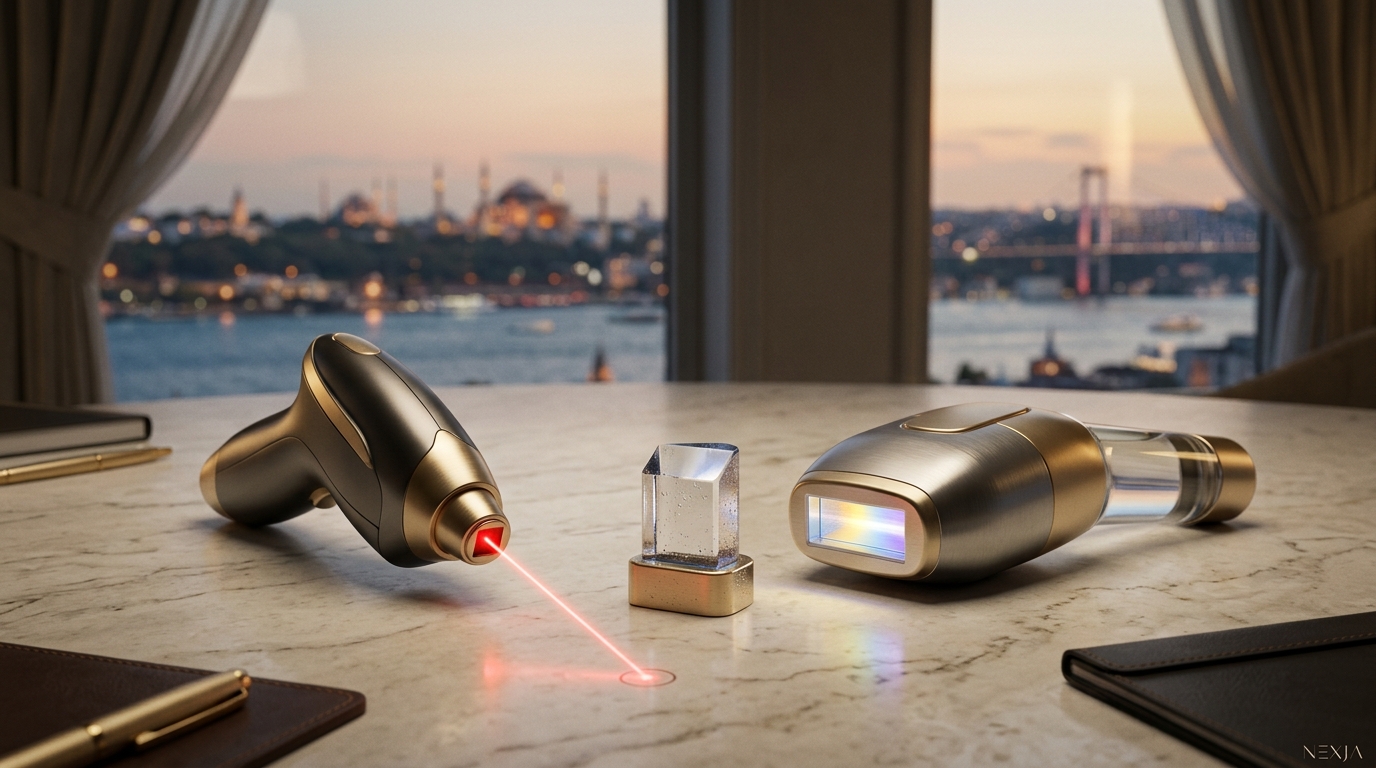
If you are comparing hair-reduction treatments in Istanbul, you will probably encounter menus that use “laser,” “IPL,” “diode,” “alexandrite,” “Nd:YAG,” “ice laser,” “four wavelength,” “pain-free,” and “all skin types” almost interchangeably. They are not interchangeable. Some terms describe how light is produced, some identify a wavelength or laser medium, some describe a cooling feature, and some are marketing labels that cannot tell you what is inside the handpiece. The useful question is therefore not which phrase sounds newest. It is whether the provider can identify the device, explain the light source and settings, assess your skin and hair, and show why the proposed plan is appropriate for you.
This guide separates the vocabulary before you book. It compares professional laser systems with intense pulsed light, explains what “ice” usually means, and gives you a practical equipment-verification checklist. It does not assume that one technology is automatically best for every person. Hair colour and thickness, skin tone, recent tanning, treatment area, medications, hormonal influences, operator training, device maintenance and parameter selection all affect the balance of benefit and risk. Cooling can improve comfort and help protect the epidermis, but it does not turn unsuitable settings into safe settings or prove that a treatment will be painless.
For a broader planning overview, read Nexja’s complete laser hair removal guide for Istanbul. If you are already deciding how many appointments may be involved, see the separate guide to session numbers and spacing. The present article has a narrower job: it helps you decode technology claims without treating a device name as a substitute for consultation.
Direct answer: laser, IPL and “ice laser” are not three equivalent laser types
A laser produces light with a defined optical architecture and typically a relatively narrow wavelength or set of specified wavelengths. Professional hair-reduction systems commonly use alexandrite around 755 nm, diode platforms in the approximate 800-nm region, or long-pulsed Nd:YAG at 1064 nm. A multi-wavelength platform may combine or sequence more than one output, but the exact architecture must be confirmed from manufacturer documentation rather than inferred from a sales label.
IPL stands for intense pulsed light. It uses a flashlamp to produce a broad spectrum of light that is shaped by filters. IPL can be used for hair reduction, but it is not a laser. The distinction is not merely semantic: spectrum, pulse structure, fluence, spot size, cooling, contact technique and operator choices influence how energy reaches hair and skin. A good IPL system in suitable hands may be a reasonable option for a suitable person; calling it a laser does not improve it, and calling all IPL ineffective is equally simplistic.
“Ice laser” is generally a commercial phrase associated with strong contact cooling, a chilled applicator or a treatment technique designed to manage heat and comfort. It is not a universally standardised scientific category. An “ice” label may sit on a diode-laser platform, an IPL device or a home-use light device. The label alone does not disclose wavelength, pulse duration, fluence, regulatory status or suitability. Ask for the manufacturer, model and technical documentation.
The shared biological idea: selective heating of pigmented hair
Laser and IPL hair-reduction methods both try to deliver light that melanin in the hair absorbs. Absorbed energy becomes heat. The aim is to create enough thermal injury in relevant follicular structures to reduce future growth while limiting injury to surrounding skin. This is why dark, coarse hair often responds more predictably than very fine, blond, white, grey or red hair: the target must contain enough appropriate pigment to absorb useful energy. It is also why epidermal melanin matters. Skin and hair can compete for light, especially after tanning or when the device, settings and skin assessment are poorly matched.
The concept is often summarised as selective photothermolysis, but a treatment room is more complicated than a diagram. Wavelength influences penetration and melanin absorption. Pulse duration affects how quickly energy is delivered. Fluence describes energy per unit area. Spot size, repetition rate, contact, pressure, overlap and cooling affect delivery. Hair diameter, depth and growth phase vary by body site. A result depends on the whole treatment system—not on one impressive number in an advertisement.
Hair grows in cycles. Light-based reduction is most effective when a follicle has an appropriately pigmented hair connected to the structures being targeted. Not all follicles are in the same stage on one day, so repeated appointments are expected. “Permanent hair reduction” is a more accurate planning concept than a guarantee of permanent removal of every hair. Maintenance may be needed, and hormonal changes can alter future growth.
What makes a laser a laser?
Laser light is generated by stimulated emission in a resonant optical system. In practical consumer language, this usually means that the device is designed around one specified wavelength or a defined combination rather than the broad filtered spectrum of a flashlamp. The wavelength is only the start of the specification. Two platforms marketed with the same nominal wavelength can differ in pulse range, peak power, spot geometry, cooling, calibration, delivery mode and permissible indications.
Alexandrite laser
Long-pulsed alexandrite systems commonly operate at 755 nm. That wavelength is strongly absorbed by melanin and can be efficient for pigmented hair when the skin–hair contrast is favourable. Because epidermal melanin also absorbs energy, recent tanning and darker skin require particular care. The device name does not decide safety; skin typing, conservative test strategy, pulse and fluence choices, cooling and operator experience remain essential. Do not interpret “alexandrite” as automatically superior or automatically unsuitable. Ask how the provider decides when to use it and when not to.
Diode laser
Diode hair-reduction systems commonly work in the region around 800–810 nm, although commercial platforms may use other nominal outputs or combine wavelengths. “Diode” describes the source technology, not one universal experience. Some systems stamp individual pulses; some use repeated lower-fluence passes; some incorporate vacuum or contact cooling. Claims such as “four wavelength diode” should be checked against the exact model’s technical file. A handpiece graphic or front-panel sticker is not proof that four therapeutically meaningful wavelengths are being delivered.
Long-pulsed Nd:YAG laser
Nd:YAG hair-reduction systems commonly use 1064 nm. This longer wavelength is less strongly absorbed by melanin than shorter hair-removal wavelengths and penetrates more deeply. In clinical literature, it is frequently discussed for darker skin types because the epidermal melanin interaction can be lower, but lower absorption also changes efficiency and comfort. “Safer for darker skin” should never be translated into “risk-free for every dark skin tone.” Settings, cooling, recent sun exposure, hair characteristics and expertise still matter.
Multi-wavelength platforms
A platform may genuinely combine wavelengths, use stacked emitters or deliver them in a defined sequence. That can offer flexibility, but the number of wavelengths is not a clinical outcome. Ask whether the outputs are simultaneous or selectable, what proportion of energy each contributes, which handpiece is being used, and how the protocol changes for your skin and hair. If the provider cannot identify the platform or produce manufacturer material, treat the numerical claim as unverified.
What IPL is—and what it is not
IPL uses a high-energy flashlamp that emits a broad range of wavelengths. Filters remove parts of that range so a selected band reaches the skin. The device may offer different cut-off filters, pulse trains and cooling options. In hair reduction, the goal is still preferential heating of pigmented hair structures, but the optical source is not coherent laser light. The broad spectrum can be useful in appropriately designed systems, yet it also means that safe and effective treatment depends heavily on filtering, pulse design, skin assessment and calibration.
Professional IPL should not be equated automatically with a low-powered home handset. Home-use devices are designed for consumer operation and normally work within different output limits and usage instructions. Likewise, the existence of an FDA-cleared home IPL device does not establish that every IPL device is cleared, that it is equivalent to a professional laser, or that it is suitable for every skin tone. Regulatory databases identify a specific manufacturer, model and intended use; they do not validate a generic marketing phrase.
Clinical comparisons between IPL and lasers do not support a one-line universal winner. Results vary by device generation, body area, treatment schedule, skin type, hair characteristics and study design. A randomised split-face study found longer median hair-free intervals with alexandrite than the specific IPL system tested after six treatments, while other studies and reviews report meaningful reduction with both. This illustrates the correct way to read evidence: it compares defined protocols, not every device that shares a category label.
What “ice laser” usually means
“Ice laser” is best understood as a prompt to ask a second question: what is the actual light source? In many commercial settings it refers to a diode platform with a chilled contact sapphire or other cooled tip. Elsewhere it may describe an IPL handset with a cooling plate. Some brands use proprietary names that include “ice,” while generic systems borrow the vocabulary. Cooling is a feature; it does not by itself identify the optical technology.
Cooling can serve two important roles. First, it may reduce heat sensation and improve comfort. Second, it can help protect the epidermis before, during or after energy delivery. Contact cooling, cryogen spray and forced cold air are different methods. Their performance depends on timing, contact, temperature, cleanliness, maintenance and how treatment is delivered. If the handpiece is moved continuously, speed and overlap become important. If individual shots are stamped, coupling and pulse spacing matter.
Cooling cannot tell the operator whether your skin is recently tanned, whether a medication is photosensitising, whether a mole should be avoided, or whether the chosen fluence and pulse duration are appropriate. It can also mask warning sensation if used carelessly. “Pain-free” is therefore not a useful guarantee. People describe warmth, snapping, pinching or discomfort differently, and sensation varies by area and settings. A professional explanation should acknowledge variability rather than promise zero pain.
Laser vs IPL comparison at a glance
| Question | Laser platform | IPL platform | What to verify |
|---|---|---|---|
| Light source | Defined laser architecture, usually a specified wavelength or documented combination | Broad-spectrum flashlamp shaped by filters | Manufacturer, model, handpiece and technical specification |
| Is it a laser? | Yes, if the documented device is a laser | No | Do not accept interchangeable terminology |
| Hair target | Melanin-dependent selective heating | Melanin-dependent selective heating | Hair colour, thickness and depth |
| Skin considerations | Depend on wavelength, pulse, cooling and settings | Depend on filter, spectrum, pulse, cooling and settings | Skin assessment, tan history and operator experience |
| Comfort | Varies; cooling may help | Varies; cooling may help | No credible zero-pain guarantee |
| Evidence | Strongest for defined devices and protocols | Meaningful evidence for defined IPL systems | Do not generalise one study to all platforms |
| Home version | Some consumer devices use laser technology | Many consumer devices use IPL | Intended use, skin-tone limits and instructions |
| “Ice” label | May refer to contact cooling | May also refer to cooling | Cooling label does not identify the light source |
Why your skin tone changes the conversation
The target pigment is in the hair, but pigment is also present in the epidermis. As epidermal melanin increases, the margin between heating hair and heating skin can narrow for some wavelengths and settings. This is why a provider should assess skin tone in the treatment area, not rely only on your ethnicity or a photo of your face. Different areas of the same person can have different recent sun exposure, baseline pigmentation and sensitivity.
A published systematic review focused on skin of colour found that the available evidence did not establish one universally optimal modality, though pooled adverse-event estimates in the included data favoured long-pulsed Nd:YAG over IPL for post-inflammatory hyperpigmentation. That is not a prescription for an individual reader. It is a reason to ask how the provider selects technology and settings for Fitzpatrick III–VI skin and what experience they have with comparable skin tones.
Recent tanning—whether from sun, solarium or self-tanning products—must be discussed. Self-tanner changes surface colour even though it does not create the same biological tanning response; it can still interfere with visual assessment and may lead a provider to postpone. Sunburn, active irritation, open skin and certain infections are reasons for reassessment. When in doubt, delay is often safer than squeezing treatment into a travel itinerary.
Why hair colour, diameter and body area matter
Dark, coarse terminal hairs contain more melanin and provide a more substantial target than pale vellus hairs. White and grey hairs lack useful melanin; conventional laser and IPL systems do not reliably target them. Red and very blond hair can also respond poorly because pigment quantity and type differ. A consultation should distinguish true terminal hair from fine facial fuzz. Treating fine hair with unsuitable parameters may produce little benefit and, in uncommon cases, paradoxical stimulation.
Body areas behave differently. Underarms and lower legs are not biologically identical to the upper lip, neck, shoulders or abdomen. Hair density, depth and cycle length vary. Facial and neck areas deserve particular caution when hair is fine or hormonally influenced. A provider should not sell a full-body package as if every area should receive the same handpiece, fluence, pulse duration and number of passes.
Hormonal conditions and medications can influence growth. Light-based treatment may reduce existing pigmented hair without addressing an underlying driver. New hair can appear later. If growth is sudden, unusually extensive or accompanied by other symptoms, medical assessment may be appropriate before a cosmetic course. A consultation should not diagnose endocrine disease, but it should recognise when referral is sensible.
The consultation should come before the machine choice
A credible consultation begins with goals and history, not a predetermined sales package. Expect questions about prior light or laser treatment, burns or pigment changes, keloid tendency, skin conditions, medications and supplements, pregnancy policies, photosensitivity, active tanning, tattoos, recent waxing or epilation, and any condition affecting healing. The provider should inspect the actual area and hair.
Next comes device selection. Ask which device and handpiece will be used today, not merely what equipment exists in the clinic. Ask why it fits your current skin and hair. If a test spot is appropriate, clarify where it will be placed, what settings will be recorded and how long the skin will be observed before full treatment. A test spot can reduce uncertainty but cannot guarantee that a larger session will have no adverse effect.
Finally, agree on a realistic plan. That includes preparation, interval, response measures, expected shedding, aftercare, conditions for postponement and a process for reporting concerns. Avoid a provider who treats questions as resistance. Technology literacy should make consent clearer, not make the conversation feel like an engineering exam.
A practical equipment-verification checklist
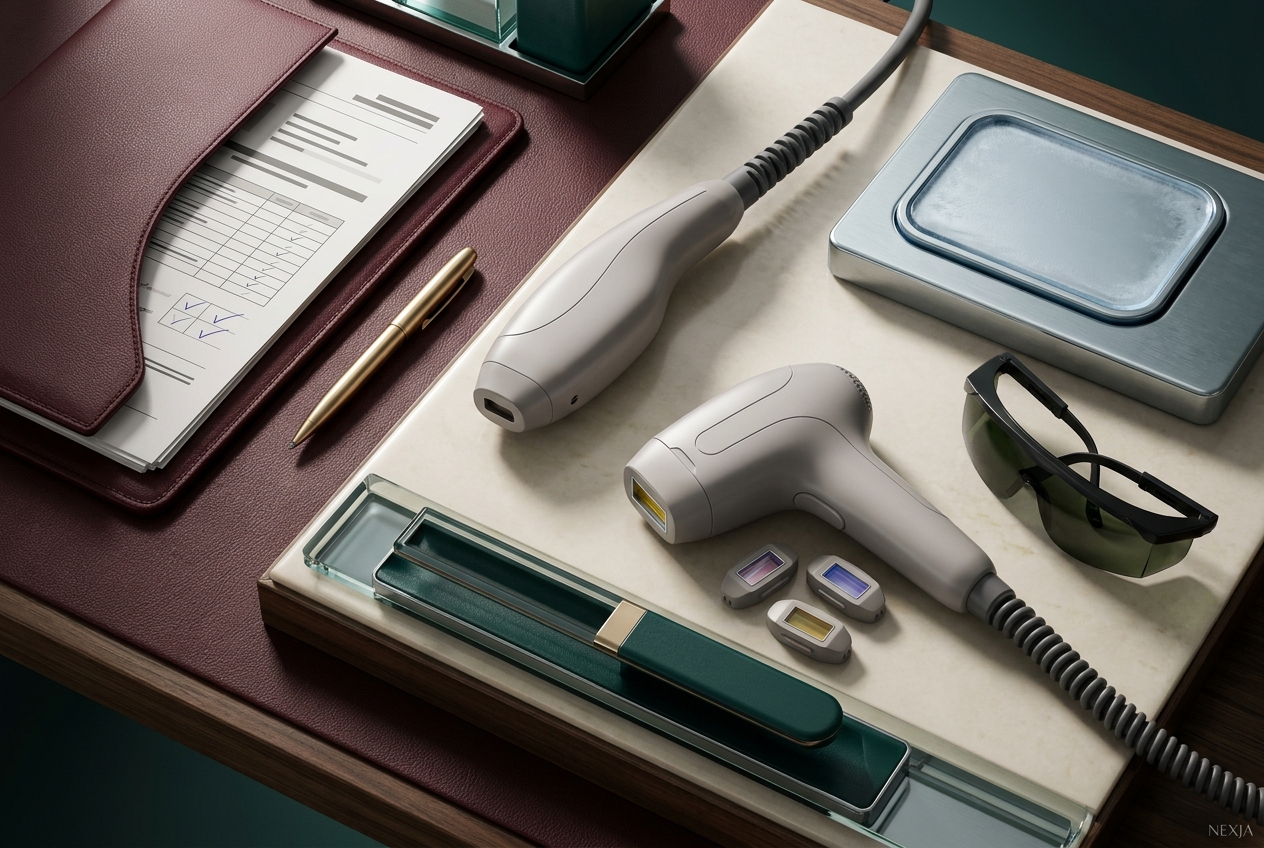
- Manufacturer and exact model: Ask for both. A generic front label is insufficient.
- Device type: Is it laser, IPL or another light-based system?
- Wavelength or filter: What does this handpiece actually deliver?
- Handpiece: Multi-platform consoles can have different applicators.
- Cooling method: Contact, air, spray or another system—and how is it maintained?
- Documentation: Can the provider show manufacturer specifications and intended use?
- Local legal status: Who is permitted to operate it, under what oversight, in this setting?
- Maintenance and calibration: How are output and cooling performance checked?
- Operator training: Is training specific to this model and to varied skin tones?
- Assessment method: How are skin tone, tan, hair and contraindications recorded?
- Parameter record: Are fluence, pulse duration, spot size, rate and passes documented?
- Eye protection: Is wavelength-appropriate protection used by everyone in the room?
- Patch testing: When is a test area advised, and how is it reviewed?
- Adverse-event plan: Who assesses a burn, blister or pigment change?
- Photography and consent: Are images optional, securely handled and not used without consent?
For Nexja’s current service information, visit the verified laser hair removal service page. This article does not claim undocumented Falcon Pro 4 wavelengths, architecture, regulatory approvals or outcomes. Falcon Pro 4 is the user-confirmed device name; its exact technical claims remain documentary checks during consultation.
How to read “four wavelength” and similar claims
More wavelengths do not automatically mean better treatment. A claim may refer to separate emitters, combined bars, selectable modes, broad output peaks or simple branding. The clinically relevant details include how much energy each wavelength contributes, whether they are delivered simultaneously, the pulse structure, spot size, repetition rate and how the platform is used for your skin and hair.
Ask for the manufacturer’s manual or official technical sheet for the exact model. Compare the model name and handpiece appearance, but remember that appearance alone is not proof. Regulatory clearance in one country applies to the specific device and intended use stated in its record; it does not transfer to a similarly named machine. “FDA registered” can refer to establishment registration or listing and is not the same as a device-specific clearance or approval. Ask the provider to state precisely what they mean.
Do not demand maximum fluence or the largest number of wavelengths. High energy is not a badge of quality. The aim is an effective, tolerable and safe exposure matched to the target. A conservative start may be appropriate in uncertain circumstances. Conversely, chronically underpowered treatment can waste time without adequate reduction. Good practice involves observation, records and adjustment—not one fixed setting for everyone.
Comfort, cooling and the myth of “pain-free” treatment
Comfort matters because it affects cooperation and treatment consistency, but it should not be used to erase risk. Contact cooling can reduce surface heat and make repeated passes more tolerable. Cold air may be useful with some platforms. Topical anaesthetic policies vary and require caution because large-area use can create systemic risk and may obscure feedback. Never apply a numbing product without explicit professional guidance.
Sensation varies with body area, hair density, menstrual cycle, anxiety, room temperature, device mode and settings. Dense coarse hair can create stronger heat. Bony areas and sensitive zones may feel different. A person who reports no pain can still develop an adverse reaction; a person who feels brief heat is not necessarily being injured. The operator should watch tissue response and communicate throughout.
If treatment feels unexpectedly intense, say so immediately. Continuing to prove toughness is not useful. The operator can pause, check contact and skin response, reassess settings or stop. Afterward, mild perifollicular redness or swelling can occur, but blistering, severe pain, spreading redness, crusting or marked pigment change requires prompt assessment rather than social-media advice.
Expected results without guarantees
The goal is progressive reduction in hair density and coarseness. Hairs may appear to grow for days after treatment before shedding. Pulling or waxing can disrupt observation; follow the provider’s instructions. A good response is usually judged over multiple sessions using comparable photographs or consistent area counts, not by inspecting the skin immediately after one visit.
No ethical provider can promise that every hair will disappear permanently. Hair cycles, biology, hormonal influences and future changes make absolute guarantees misleading. Published research often reports reduction at defined follow-up points, using defined devices and protocols. Those results cannot be imported directly into your package without considering differences in device, operator, skin, hair and adherence.
Maintenance is not necessarily evidence of failure. The meaningful question is whether density, regrowth speed and hair calibre improved enough to justify cost, time and risk. Agree in advance on when progress will be reviewed. If there is little change after appropriately timed sessions, reassess diagnosis, hair suitability, technique and documentation before simply buying more.
Preparation: what usually matters
Avoid waxing, threading or epilating the target hair for the period advised by the provider because the follicular target needs to be present. Shaving is usually used to shorten surface hair while preserving the target below. The exact timing depends on the area and provider instructions; the surface should not be cut or irritated. Do not arrive with heavy oils, deodorant, makeup or active products unless told otherwise.
Report sun exposure, tanning products and any skin change. List prescriptions, over-the-counter medicines and supplements rather than deciding yourself which are relevant. Photosensitising potential and healing considerations can be complex. Do not discontinue prescribed medication to fit a cosmetic appointment; ask the prescriber and treatment provider.
Tell the clinic about tattoos, permanent makeup, pigmented lesions and recent procedures. These areas may need to be avoided or shielded. Eye protection must match the device and wavelength; closing your eyes or wearing ordinary sunglasses is not a substitute. If instructions are unclear, postpone rather than improvise.
Aftercare and when to seek help
Follow the device- and area-specific instructions you receive. Common advice may include gentle cleansing, avoiding friction and heat, postponing strenuous exercise or hot bathing for a short period, and protecting the area from ultraviolet exposure. These are not universal time rules. Skin response, body area and treatment intensity matter.
Use simple products unless the provider has advised otherwise. Strong acids, retinoids, exfoliants, fragranced products and aggressive scrubbing may worsen irritation. If sunscreen is suitable for the area, use broad-spectrum protection and physical shade. Do not pick crusts or blisters.
Contact the provider promptly for severe or increasing pain, blistering, burns, pronounced swelling, spreading redness, discharge, extensive crusting or significant colour change. Ask before booking how out-of-hours concerns are handled, especially if you are travelling. Urgent symptoms such as facial swelling, breathing difficulty or signs of severe allergic reaction require emergency care.
Planning treatment during an Istanbul visit
Istanbul travel adds practical variables: sun exposure while sightseeing, long outdoor days, swimming, hammam or sauna plans, tight clothing, flights and limited follow-up time. Do not arrange a first high-intensity session immediately before an important event or departure without discussing contingency planning. Leave room to observe your skin and communicate with the provider.
Fatih is Nexja’s real location context, but distance estimates should be checked against your accommodation and current traffic. Choose a provider for assessment, documentation and follow-up rather than for the nearest map pin alone. A consultation can be valuable even if the decision is to postpone.
If you will continue the course in another country, request a treatment record that identifies the device, handpiece, settings, area, response and date. The next provider may still need to reassess and test; a written record is more useful than “ice laser level six.”
Myths vs Facts
Myth: IPL and laser are the same technology
Fact: Both use light to target pigmented hair, but IPL uses a filtered broad-spectrum flashlamp while a laser has a defined laser architecture and wavelength output. The distinction affects how specifications and evidence should be interpreted.
Myth: “Ice laser” is a scientific laser category
Fact: “Ice” usually describes cooling or branding. Identify the underlying device as laser, IPL or another system and check the exact model.
Myth: More wavelengths always mean better results
Fact: Suitability depends on the complete system, actual outputs, settings, skin, hair and operator. A wavelength count is not an outcome.
Myth: Cooling makes any setting safe
Fact: Cooling can improve comfort and protect the epidermis, but it cannot correct an unsuitable wavelength, excessive energy, poor overlap, recent tan or inadequate assessment.
Myth: A painless session cannot cause a burn
Fact: Sensation is an imperfect safety monitor. Tissue response, device records and follow-up matter.
Myth: Darker skin cannot receive laser hair reduction
Fact: People across skin tones may be treated, but technology selection, settings and operator experience with comparable skin are crucial. Risk is never zero.
Myth: White or grey hair responds like dark hair
Fact: Conventional laser and IPL depend on melanin. Hair without useful pigment is a poor target.
Myth: One session permanently removes all hair
Fact: Hair cycles require repeated treatment, results vary, and maintenance may be appropriate.
Myth: FDA registration proves every marketing claim
Fact: Establishment registration, device listing, clearance and approval are different concepts. Verify the exact model and intended use in the relevant record.
Myth: The highest setting is the most professional
Fact: Professional treatment balances target heating with skin protection and adjusts parameters to the person and response.
Frequently asked questions
1. Is “ice laser” actually a laser?
Not necessarily. The term usually refers to cooling, a proprietary brand name or a marketing description. It may be attached to a diode laser, an IPL device or a consumer light handset. Ask for the manufacturer, exact model, handpiece and documented light source. If the platform is a laser, the technical file should identify its wavelength architecture. If it uses a flashlamp and filters, it is IPL. The useful next step is to request the official specification rather than deciding from the treatment name.
2. Is IPL weaker than laser?
“Weaker” is too vague to guide a booking. IPL and lasers produce light differently, and output cannot be compared by one label. A professional IPL system may deliver meaningful hair reduction for a suitable person, while an unsuitable or poorly operated laser may perform badly. Compare the exact device, filter or wavelength, pulse structure, fluence, cooling, skin and hair match, and published protocol. Ask how the clinic measures progress and when it would change the plan.
3. Which is better: diode, alexandrite or Nd:YAG?
There is no universal winner. Alexandrite, diode and long-pulsed Nd:YAG systems have different optical and practical characteristics. The balance changes with skin tone, tan status, hair colour, diameter, depth, body area and device design. A provider should explain why a particular handpiece is appropriate today and record the parameters. If the answer is only that one device is “the newest,” request a more specific assessment.
4. Can IPL permanently remove hair?
Use the term permanent hair reduction cautiously. IPL can reduce pigmented hair with repeated treatments, but complete permanent removal of every hair cannot be guaranteed. Results depend on the system, settings, course timing and biology. New or hormonally influenced growth may occur. Ask for device-specific evidence, realistic endpoints and a maintenance policy instead of an absolute promise.
5. Does cooling mean the session is risk-free?
No. Cooling can protect the skin surface and improve comfort, but risks such as burns, blistering and pigment alteration remain possible. Cooling performance also depends on contact, timing and maintenance. Safety still requires a suitable device, correct settings, tan assessment, eye protection and trained operation. Report unexpected heat immediately and ask how post-treatment concerns are managed.
6. Can I choose a device from an online photo?
A photo may help confirm that a clinic appears to have a certain console, but it cannot prove internal components, maintenance, handpiece, calibration or the device used at your appointment. Counterfeit housings and generic rebranding also exist. Ask to see the exact model label and manufacturer documents in person. Then focus on assessment and operator competence rather than appearance alone.
7. What does “four wavelength” mean?
It may mean four documented laser outputs, a stacked emitter design, selectable bands or simply a marketing label. Ask whether the wavelengths are simultaneous or selectable, how energy is divided, and which official document supports the claim. Four wavelengths do not prove suitability for every skin type, nor do they remove the need for parameter selection and cooling.
8. Is one wavelength enough?
A well-designed single-wavelength platform can be effective when matched to the person and operated appropriately. More wavelengths can offer flexibility, but flexibility is useful only when the outputs are genuine and the operator knows how to select them. The goal is not to collect wavelengths; it is to treat the target while protecting skin.
9. Why do clinics ask about tanning?
Tanning increases epidermal melanin, which can absorb treatment light and reduce the safety margin. It may require postponement or a different plan. Self-tanner also affects visual assessment. Tell the clinic about sun, solarium and tanning products honestly; concealing a tan to keep an appointment increases risk.
10. Can darker skin tones be treated?
Yes, people with darker skin may receive professional hair-reduction treatment, but the provider must understand skin-of-colour safety and select appropriate technology and settings. Ask about experience with comparable skin tones, test strategy and management of pigment changes. Do not accept either blanket refusal or blanket “safe for everyone” claims without explanation.
11. Does laser work on blond, red, grey or white hair?
Response is limited when the hair lacks sufficient target melanin. Grey and white hair are generally poor candidates for conventional laser and IPL. Very light blond and red hair may respond unpredictably. An honest consultation may recommend another method rather than selling a long course with little biological basis.
12. Can fine facial hair get worse?
Paradoxical hair stimulation is uncommon but reported after laser and IPL, especially in certain facial and neck contexts. Risk appears related to area, hair characteristics, skin type and treatment parameters. Ask whether the hair is terminal enough to target and whether non-treatment or another method is safer. Document baseline hair before starting.
13. Is a patch test a guarantee?
No. A test spot can help assess immediate and delayed response to selected parameters, but a small area does not reproduce every feature of a full session. It cannot eliminate risk. Ask how long to observe it and what changes should be reported. A provider should still monitor and adjust during treatment.
14. How many sessions will I need?
There is no reliable number without considering area, hair, skin, biology, technology and intervals. Multiple sessions are expected because follicles cycle asynchronously. Ask for a range and review point rather than a fixed guarantee. For more detail, use Nexja’s guide to how many laser hair removal sessions may be needed.
15. Why are sessions spaced apart?
Spacing allows time for treated hair to shed and for another group of follicles to enter a targetable growth stage. The appropriate interval differs by body area and response. Booking too frequently may add cost without targeting substantially more hair. Ask the provider to justify changes in spacing from observed regrowth.
16. Should I wax before treatment?
Usually no, because waxing or epilation removes the pigmented hair structure the light is intended to target. Shaving is commonly used to shorten surface hair while keeping the follicular target. Follow the clinic’s area-specific timing and avoid cutting irritated skin. If you have waxed recently, disclose the date and reschedule if advised.
17. Can I have treatment after sun exposure?
Recent sun exposure may increase risk and can justify postponement. The decision depends on visible or biological tanning, area, device and settings. Do not rely on “I did not burn.” Tell the provider when and how long you were exposed, and use sun protection throughout the course.
18. Are home IPL devices the same as clinic IPL?
No. Home devices are designed for consumer use and typically operate under different limits, instructions and safeguards. Some are cleared for specific intended uses, but that does not make every home device equivalent. Follow the exact manual, skin-tone chart and contraindications; never use a home device near the eyes or on prohibited areas.
19. Does an FDA listing mean the device is approved?
Not automatically. Establishment registration, device listing, 510(k) clearance and premarket approval are distinct. A specific database entry must be matched to the manufacturer and model. Ask the provider to state the exact claim and show the record. Do not accept a logo as proof.
20. What eye protection is required?
Protection must be suitable for the device’s wavelength or spectrum and worn by the client and everyone in the treatment room. Ordinary sunglasses, cotton pads or closed eyelids are not substitutes. Treatment close to the eyes needs especially careful boundaries and professional judgement. If appropriate protection is not provided, do not proceed.
21. What should a clinic record?
A useful record includes device and handpiece, treatment area, skin and hair assessment, settings, cooling, number of passes, immediate response, adverse events and aftercare. Photographs require consent and secure handling. Records help review progress and investigate reactions; they are also valuable if you transfer care.
22. Can treatment be completely painless?
Some people find modern cooled treatments very tolerable, but no provider can guarantee zero sensation for every area and setting. Comfort varies. A credible provider explains expected sensations, invites feedback and adjusts safely rather than using “pain-free” as proof of quality.
23. Is redness normal?
Mild transient redness and swelling around follicles can occur, but response varies. Severe or increasing pain, blistering, extensive crusting, spreading redness or marked pigment change is not something to ignore. Follow written aftercare and contact the provider promptly if symptoms are concerning.
24. Can I exercise after treatment?
Heat, sweat and friction may aggravate recently treated skin. The necessary pause depends on area, intensity and response; there is no single universal number. Ask for written instructions and plan the appointment around exercise, sauna, hammam and swimming.
25. Can laser or IPL treat ingrown hairs?
Reducing coarse hair can reduce a driver of recurrent ingrown hairs, but active inflammation, infection or scarring may need medical evaluation. Hair reduction is not a substitute for diagnosing another skin condition. Ask whether the area should be calmed before treatment and how active lesions will be avoided.
26. What if I have tattoos or permanent makeup?
Pigment can absorb light and may burn or change colour. Tattoos and permanent makeup generally need to be avoided with an appropriate margin. Tell the provider about all pigment, including cosmetic tattooing that has faded. Never allow a hair-removal handpiece to fire directly over a tattoo.
27. Can I have treatment while taking medication?
It depends on the medicine, dose, indication, skin condition and provider policy. Some drugs or supplements may affect photosensitivity, bruising or healing. Provide a complete list and do not stop prescribed treatment without medical advice. Postponing a cosmetic session is safer than changing necessary medication on your own.
28. How can I compare prices fairly?
Compare the defined area, device and handpiece, consultation, operator, number of passes, consumables, follow-up, cancellation rules and whether tax is included. A low per-session price may not be good value if treatment is unsuitable or under-documented. Nexja prices can change, so request a current written quote rather than relying on an old post.
29. What should international visitors ask before booking?
Ask how consultation, patch testing, follow-up and adverse-event support fit your travel dates. Request the full address in Fatih, current appointment time, cancellation terms and written treatment record. Allow time before flights and important events. Avoid scheduling around intense sun, hammam or swimming plans.
30. What is the single most useful question to ask?
Ask: “What exact device and handpiece will you use on me today, and why is it suitable for my current skin, hair and treatment area?” A good answer should connect documentation with your assessment, not repeat a slogan. If the provider cannot identify the device or explain the plan, pause before paying.
Questions to take to your consultation
- Is this device a laser or IPL, and what exact model is it?
- Which wavelength or filter will be used on this area?
- What does “ice” mean on this platform?
- How do you assess recent tanning and skin tone?
- Is my hair sufficiently dark and coarse to target?
- Why is this technology preferable to the alternatives for me?
- What settings and response will be recorded?
- When would you postpone or refuse treatment?
- What adverse reactions have you seen, and how are they managed?
- What result would count as inadequate at the review point?
Bottom line
Laser, IPL and “ice laser” should not be chosen as competing buzzwords. Laser identifies an optical technology; IPL identifies a different broad-spectrum light technology; “ice” usually identifies cooling or branding. Each can only be evaluated in the context of an exact device, documented output, suitable person, skilled operator and transparent treatment plan.
In Istanbul, the safest comparison is not “Which name is best?” but “Can this provider prove what the device is, explain why it fits me, record what they do and support me if my skin reacts?” Use the terminology as a starting point for informed consent. Do not let a cold handpiece, wavelength count or regulatory logo replace consultation.
A five-minute booking check
Before paying, pause and work through five questions. First, can the clinic name the exact device and handpiece? Second, can it say whether the source is laser or IPL without blurring the terms? Third, can it connect the proposed technology to your current skin, hair and area? Fourth, does it have a documented method for eye protection, settings, response and aftercare? Fifth, can it explain what happens if treatment is postponed, ineffective or followed by a reaction? A clear answer to all five does not guarantee a result, but it demonstrates a more credible consent pathway.
If the answer relies mainly on “ice,” “pain-free,” “four wavelength,” “medical grade” or a regulatory logo, slow down. Ask for the underlying fact. “Ice” should lead to a cooling explanation. “Four wavelength” should lead to an official model specification. “Medical grade” should lead to an identifiable legal or technical classification rather than a prestige phrase. “FDA approved” should lead to an exact database record and intended use. If the claim cannot survive one calm follow-up question, it should not determine a prepaid course.
Then check your own readiness. Have you disclosed tanning, products, medicines, previous reactions, tattoos and the last method used to remove hair? Is the hair dark and substantial enough to target? Can you follow aftercare and contact the clinic if symptoms appear? Do your travel plans allow observation? Good technology cannot compensate for incomplete history or an impossible schedule.
Finally, separate the booking decision from the package decision. It may be reasonable to book a consultation or carefully selected first session without committing to a large course. Use the early response to assess tolerability, shedding, coverage and communication. A professional provider should be comfortable with an informed pace. Pressure to purchase before assessment is information about the service model, not evidence about the machine.
What a transparent treatment record can look like
A useful record does not need to be complicated. It can list the date, exact device and handpiece, area, baseline skin and hair observations, recent sun exposure, relevant changes in medication, fluence or platform level, pulse duration, spot size, repetition rate, pass count or movement method, cooling, immediate tissue response and aftercare. If the platform uses a proprietary mode instead of conventional parameter labels, the mode and any available underlying settings should be recorded.
At the next visit, the operator can compare what happened: how long redness lasted, whether shedding occurred, whether there were missed strips, how much regrowth is present, and whether pigment or texture changed. This creates a reasoned basis for adjustment. It also prevents a new operator from assuming that “last time was fine” means the same settings are correct today.
For international clients, ask for a simple copy or summary. It can help another provider understand what was used, although the new provider must still assess you independently. Do not rely on a device nickname or a photo of the display alone. A portable record is especially valuable if a delayed pigment change or burn needs evaluation after you leave Istanbul.
Transparent documentation protects both client and provider. It supports quality improvement, distinguishes expected temporary effects from complications, and makes marketing claims testable against actual practice. A clinic that records carefully is not promising perfection; it is showing that treatment is a process that can be reviewed.
How treatment parameters change what the same machine can do
A device model is not a complete treatment description. The same console can be used with different fluence, pulse duration, spot size, repetition rate, cooling and movement technique. Those choices change how energy is distributed and how quickly heat accumulates. This is why a photograph of a familiar machine cannot prove that a session will match a study or another clinic’s result.
Fluence is not a quality score
Fluence is commonly expressed as joules per square centimetre, but a higher number is not automatically more effective or more professional. Numbers cannot be compared cleanly across different devices, wavelengths, spot sizes, calibration systems and pulse structures. A setting must produce an appropriate follicular effect while protecting skin. The operator should interpret the immediate response and your history, not chase a maximum display value.
Very low delivery may fail to create useful thermal injury, while excessive delivery can burn skin. The reasonable range changes with hair density, skin pigment, anatomical site and cooling. If a clinic advertises one universal energy level, ask how it handles a recently tanned lower leg versus an untanned underarm or a coarse beard-pattern area versus fine upper-arm hair. Those are not equivalent targets.
Pulse duration changes the heating pattern
Pulse duration describes how long energy is delivered in a pulse or pulse train. It interacts with target size and thermal relaxation. Coarse hair and fine hair do not necessarily call for the same temporal delivery. Epidermal safety also matters. A provider does not need to teach you laser physics, but should be able to explain that pulse duration is adjusted deliberately rather than selected from a memorised package label.
Spot size and contact affect penetration and uniformity
Spot size influences depth and scattering, while contact affects cooling and energy delivery on many platforms. Poor contact, gaps, excessive overlap or inconsistent pressure can create patchiness or hot spots. Curved areas require particular attention. A skilled operator maps the area and maintains a repeatable pattern rather than moving randomly until the skin feels warm.
Repetition rate and movement technique affect heat accumulation
High repetition rates can make treatment faster, but speed is not automatically better. In a moving technique, the handpiece may deliver multiple lower-energy pulses as it passes repeatedly over an area. Total deposited energy depends on pass count, speed and overlap. In a stamped technique, individual pulses may be placed in an organised grid. Ask which method the device manufacturer supports and how the operator prevents untreated gaps or excessive stacking.
Cooling must be integrated, not advertised separately
Cooling before a pulse, during contact and after delivery can have different effects. A displayed handpiece temperature may not equal the temperature at every point of the skin. Cleanliness and intact contact surfaces matter. If gel is required, the correct gel and layer may affect optical coupling. The operator should inspect the cooling window and respond to reports of uneven heat rather than treating the “ice” label as self-verifying.
Operator technique can matter as much as the device category
Laser and IPL are energy-delivery procedures. An operator must combine device training with skin assessment, anatomy, hygiene, eye safety, parameter documentation and recognition of adverse reactions. A certificate from a short course does not, by itself, establish competence with every platform or skin type. Ask who performs the procedure, what model-specific training they have and who provides clinical oversight when a reaction occurs.
Good technique begins before firing. The area should be identified accurately, cleaned as required and checked for cuts, irritation, tattoos, pigmented lesions and products. Hair should be at the instructed length. Protective eyewear must be selected for the output. The handpiece window should be clean and intact. The operator should confirm the device, handpiece and plan verbally rather than relying on a package name in the booking system.
During treatment, systematic coverage matters. The provider should avoid unauthorised tattoo exposure and be cautious around lesions. Tissue response is monitored continuously. If an unusual reaction occurs, the provider should stop and reassess rather than adding more cooling and continuing automatically. After treatment, the area should be examined and the record completed before you leave.
Continuity improves interpretation. If different operators treat you, each should read the prior record and assess the current skin rather than copy the last settings. Settings may need to change as hair becomes finer or your sun exposure changes. A course is a sequence of new decisions, not a prepaid conveyor belt.
How to interpret clinical studies without overpromising
Research can help distinguish plausible claims from slogans, but study results need context. Look at the exact device and wavelength, participant skin types, body area, hair characteristics, number and spacing of treatments, comparison method, follow-up duration and definition of reduction. A percentage measured a few weeks after treatment is not equivalent to long-term reduction months later.
Split-body and split-face trials are useful because each participant acts partly as their own control, reducing some biological variation. Yet sample sizes can be small and one side may receive a specific alexandrite protocol while the other receives one specific IPL configuration. The conclusion does not make all alexandrite systems superior to every IPL system. It tells us what happened under those defined conditions.
Systematic reviews collect multiple studies, but they inherit differences and limitations from the included evidence. Reviews of adverse events also depend on reporting quality; mild events may be under-recorded, while unusual events may be published precisely because they are unusual. Use reviews to understand risk patterns, not to calculate your personal probability from a headline.
Before-and-after photographs are even easier to misread. Lighting, camera angle, shaving, interval since the last session and hair-cycle timing can change appearance. A credible progress image uses similar lighting, distance and timing. A clinic’s image proves only that the pictured case was photographed, not that you will obtain the same result. Consent and privacy should be explicit.
Adverse effects: what the evidence asks providers to take seriously
Most people expect temporary warmth, perifollicular redness or swelling. Reviews of laser- and IPL-assisted hair removal also describe burns, blistering, crusting, pigment alteration, scarring, ocular injury and paradoxical hypertrichosis. Frequency varies by device, protocol, skin type, area and reporting method. The existence of risk does not mean treatment is inappropriate; it means consent and safeguards must be real.
Burns and blistering
Thermal injury can occur when energy delivery exceeds the skin’s tolerance, cooling is inadequate, contact or overlap is poor, or tanning and products alter absorption. Pain can be an early warning, but not always. Stop if heat is escalating. A blister should not be deliberately opened. Obtain prompt professional assessment and follow wound-care instructions designed for the actual injury.
Hyperpigmentation and hypopigmentation
Skin can darken or lighten after inflammation. Risk is influenced by skin type, ultraviolet exposure and treatment injury. Some changes resolve; others may persist. Strict sun protection and early review are important. Avoid attempting to correct pigment change with aggressive acids or another energy procedure without assessment.
Paradoxical hypertrichosis
Paradoxical hypertrichosis means increased or coarsened hair growth after light-based treatment. A systematic review and meta-analysis describes it as uncommon and associated particularly with certain anatomical locations. The mechanism is not fully settled. Fine facial or neck hair deserves careful selection. If growth appears to worsen, document it and reassess rather than repeating the same ineffective parameters indefinitely.
Eye injury
Laser and IPL output can damage ocular structures. Risk is especially concerning near the eyes and when protection is inadequate. Wavelength-appropriate eyewear and controlled treatment boundaries are non-negotiable. Reflective surfaces and observers also matter. Report visual symptoms urgently.
Scarring and infection
Scarring is uncommon but possible after deeper injury. Infection may complicate damaged skin. Picking, friction, contaminated contact surfaces and inappropriate aftercare can worsen risk. Ask who will assess delayed complications, especially if you will leave Istanbul soon.
Regulatory language: clearance, approval, registration and CE marking
Device marketing often compresses regulatory concepts into one reassuring logo. Resist that shortcut. In the United States, establishment registration and device listing are administrative requirements and do not necessarily mean the FDA has reviewed a device for the claim being advertised. A 510(k) clearance generally reflects a finding of substantial equivalence for a specified device and intended use; it is not the same as premarket approval. The exact database record matters.
European conformity language has its own legal framework and documentation. A CE mark should be tied to the manufacturer, notified-body information where applicable, device identification and intended purpose. It should not be treated as a universal guarantee of superior results. Türkiye has its own regulatory and professional rules; ask the provider for current local documentation and who is authorised to operate the equipment. This guide does not certify a clinic or device.
When verifying a claim, record the exact model number from the data plate, the legal manufacturer and the claimed indication. Search the relevant official database or ask for a declaration and technical document. If the record names a home-use IPL device, it does not validate a professional laser console with a similar brand. If a distributor’s brochure uses a different model suffix, clarify the difference.
Also distinguish product status from operator competence. A properly documented device can still be used poorly. Conversely, an experienced operator cannot transform an undocumented or unsuitable platform into a verified one. Both equipment and practice need scrutiny.
A decision framework for choosing between laser and IPL
Start with candidacy. Is the hair pigmented and substantial enough to target? Is the skin currently healthy and untanned enough for assessment? Are there medical, medication or travel reasons to delay? If candidacy is weak, debating diode versus IPL is premature.
Next, evaluate the provider’s options. A clinic with one device may still provide excellent treatment if it selects suitable clients and refers or declines others. A clinic with many platforms is not automatically better if it uses them interchangeably without documentation. Ask what the provider would choose for you and what finding would change that choice.
Then evaluate evidence for the exact platform. Manufacturer documents should establish the technology and intended use. Independent clinical literature can inform expectations, but it may not study the same model. Treat branded outcome claims separately from established principles. If the provider uses Falcon Pro 4, request model-specific documents for wavelengths, architecture and approvals rather than assuming them from the name.
Finally, evaluate the care pathway. A good plan includes preparation, baseline record, eye safety, parameter record, progress review and reaction management. If an IPL provider offers all of that while a laser provider cannot identify its settings, the category label alone should not drive the decision. If both pathways are credible, personal suitability, comfort, availability and informed preference can help decide.
| Your situation | Useful question | Potential next step |
|---|---|---|
| Very light, grey or white hair | Is there enough target melanin? | Discuss alternatives before buying a course |
| Darker skin tone | What experience and protocol do you have for comparable skin? | Consider documented long-wavelength options and test strategy |
| Recent tan | How does this change risk? | Postpone until appropriately reassessed |
| Fine facial hair | Could treatment be ineffective or stimulate growth? | Seek careful assessment; non-treatment may be appropriate |
| “Ice laser” offer | What is the actual light source and model? | Verify documents before comparing price |
| Four-wavelength claim | How are outputs delivered and documented? | Review official technical material |
| International visitor | Who manages delayed reactions after departure? | Plan observation time and obtain records |
Red flags before paying for a package
- The provider calls IPL a laser after being asked directly.
- The model name or manufacturer cannot be identified.
- “Ice” or “four wavelength” is offered as the entire safety explanation.
- Every skin tone, hair colour and body area receives the same plan.
- There is a permanent, painless and risk-free guarantee.
- No one asks about tanning, medication, prior reactions or skin conditions.
- Eye protection is missing, generic or optional.
- Tattoos and pigmented lesions are treated directly without explanation.
- The operator refuses to stop when heat feels abnormal.
- Settings and device details are not recorded.
- A regulatory logo is shown without a model-specific record.
- You are pressured to buy a long course before assessment.
- There is no pathway for burns, pigment change or delayed concerns.
- Before-and-after photographs have inconsistent lighting or no consent explanation.
- The clinic advises stopping prescribed medicine without the prescriber.
Green flags that support an informed choice
- The consultation separates technology facts from expected outcomes.
- The provider identifies the exact console and handpiece.
- The proposed choice is linked to your skin, hair and area.
- Limitations for pale or fine hair are explained before payment.
- Recent tanning triggers reassessment or postponement.
- Wavelength-appropriate eye protection is routine.
- Test strategy is explained without being sold as a guarantee.
- Settings, response and changes are documented each visit.
- Progress is reviewed with consistent measures.
- The clinic can decline unsuitable treatment.
- Aftercare is written and specific to the area and response.
- Delayed concerns have a named contact and escalation path.
Building a sensible course rather than buying a slogan
At the first visit, define the area precisely and photograph it consistently if you consent. Record hair removal methods and the date of the last wax or epilation. Note sun exposure and products. Agree on what improvement would be meaningful: lower density, slower regrowth, finer hair or reduced ingrown hairs. Without a baseline, both client and provider may rely on memory.
During early sessions, review tolerability and shedding rather than escalating automatically. A lack of dramatic redness does not prove that a treatment was ineffective, and intense inflammation does not prove effectiveness. The provider should interpret the pattern of regrowth and adjust timing. If large untreated strips remain, coverage technique may need attention.
At a defined review point, compare results with baseline under similar conditions. If coarse hair is clearly reduced, continue or adjust as planned. If there is minimal change, check whether the target was suitable, intervals were appropriate, settings were adequate and the device was used as documented. If hair is becoming finer, the risk–benefit balance may change. Continuing forever because a package exists is not a clinical rationale.
At the end of the initial course, discuss maintenance only if needed. Hormonal and biological changes can produce new growth over time. Maintenance frequency should respond to actual regrowth, not an automatic monthly subscription. Keep your records if you move or change providers.
Additional FAQs about terminology and provider selection
31. Can the word “diode” describe IPL?
No. A diode laser and a flashlamp IPL system are different source technologies. Some consumer marketing uses “diode” loosely because the device contains semiconductor components or LEDs, but that does not establish laser output. Verify the optical source in the official specification. If the provider cannot distinguish diode laser from IPL, ask for a more qualified explanation before proceeding.
32. Is alexandrite always too risky for olive skin?
Not as an absolute rule. Risk depends on the actual skin tone, tanning, device, pulse, fluence, cooling and operator experience. Some olive-toned people may be treated with carefully selected alexandrite parameters; others may be better suited to another wavelength or postponement. An in-person assessment is more useful than assigning technology from ethnicity alone.
33. Does Nd:YAG guarantee good results on every dark skin tone?
No. Long-pulsed 1064-nm Nd:YAG is often discussed for darker skin because of its optical characteristics, but efficacy and tolerability still depend on hair, settings, technique and individual response. Very fine or pale hair remains a poor target. “Commonly selected” should not become “guaranteed safe and effective.”
34. Should I ask for the device serial number?
The exact model and manufacturer are usually the first practical checks. A serial number can be useful when authenticity, maintenance or a reported incident must be traced, but clients may not need to record it routinely. If a regulatory or manufacturer claim is central to your decision, model-specific documentation and the data plate are reasonable requests.
35. What if the clinic says its settings are confidential?
A clinic may not want to debate proprietary protocols, but your treatment record should still identify clinically relevant parameters and the device used. Informed consent requires more than a secret level number. Ask what information will be recorded and available if you transfer care or experience an adverse event. Refusal to document basic treatment data is a concern.
36. Can two clinics use the same machine and get different results?
Yes. Assessment, maintenance, calibration, handpiece condition, settings, overlap, cooling, intervals and client selection can differ. The same brand name does not standardise practice. Compare the complete care pathway and the operator’s reasoning, not only the console.
37. Is a cold handpiece proof that cooling works correctly?
No. Feeling cold confirms only that the surface seems cool at that moment. It does not prove uniform temperature, adequate contact during every pulse, internal calibration or correct settings. Cooling should be checked and maintained as part of the system. Report uneven or unexpectedly hot areas during treatment.
38. Should all body areas use the same technology?
Not necessarily. Hair depth, density, thickness and skin exposure vary by area. A provider may use one versatile platform with adjusted parameters or select different handpieces. The important point is that the decision is reasoned and documented. Full-body treatment should not mean identical settings from face to lower legs.
39. Can AI skin analysis choose the laser for me?
Digital or AI-assisted imaging may organise observations, but it is not a medical diagnosis and should not replace history, physical inspection or professional judgement. Ask what the system measures, how data are stored and who interprets it. Device selection remains a human clinical and technical decision.
40. When is choosing no treatment the best option?
Non-treatment or postponement may be best when hair lacks target pigment, growth is too fine, skin is tanned or inflamed, medication or health history creates uncertainty, follow-up is impossible, or the device and operator cannot be verified. Declining an unsuitable package is a successful informed decision, not a failed consultation.
How to verify an “ice” or cooling claim during the appointment
Cooling is valuable, but the phrase “ice technology” should lead to observable questions rather than instant reassurance. Begin by asking which cooling method the exact handpiece uses. A contact-cooled window, forced cold air and cryogen spray are different systems with different checks. Ask whether cooling is active before, during or after the light pulse, how the surface is cleaned, how the provider checks that temperature and flow are within the manufacturer’s range, and what happens if the client reports one hot edge or an abrupt change in sensation.
Next, watch whether the explanation connects cooling to treatment technique. With contact cooling, complete and even contact may matter; curved areas can make that harder. With a moving technique, handpiece speed and overlap influence heat accumulation even when the tip feels cold. With stamped pulses, spacing and repeated firing over one point matter. A credible operator can describe how coverage is mapped, how the skin response is monitored and when treatment would stop. “The screen says minus degrees” is not, by itself, evidence of uniform epidermal protection.
Then separate comfort from dose. Strong cooling may make a session feel easier, but low discomfort cannot prove that follicles received an effective exposure. Conversely, more pain does not prove better treatment. Progress should be judged by documented shedding, regrowth pattern, density and hair calibre over an appropriate interval—not by how cold or intense the appointment felt. If the clinic increases settings, it should explain the reason and consider changes in tan, hair thickness and prior response.
Finally, ask what evidence supports the product-level claim. If “ice laser” is presented as a named technology, request the manufacturer’s official material for the exact model and handpiece. Check whether that document identifies a laser wavelength, an IPL spectrum, a cooling component or a proprietary operating mode. A distributor leaflet or social post can be a starting point, but it should not replace the technical file. If Nexja uses Falcon Pro 4 for a proposed appointment, the appropriate next step is model-specific documentation; this article does not infer wavelength architecture, regulatory status or clinical superiority from the name alone.
What to document after the first session
Record the date, treated area, exact device and handpiece, any settings the provider shares, the cooling method and the skin’s immediate appearance. Note how long warmth or redness lasts and whether swelling is limited to follicles or becomes diffuse. Over the following days, avoid testing the area with aggressive exfoliation or deliberate sun exposure. Follow written aftercare, and photograph any unexpected change in consistent lighting if the provider asks you to monitor it.
When hair begins to shed, distinguish shedding from instant disappearance. Some treated hairs can remain in the follicular canal before releasing. Track when regrowth becomes visible and whether coverage appears even. Patchy strips may reflect technique, anatomy or hair-cycle variation; they should be reviewed rather than automatically retreated. If there is blistering, increasing pain, extensive crusting, marked swelling, visual symptoms or a rapidly changing pigment response, contact the provider promptly and seek appropriate medical assessment when advised.
Bring this record to the next visit. A responsible course uses new evidence to decide whether to repeat, adjust, postpone or stop. If the provider cannot explain what was used previously, dismisses an adverse response or insists that every reaction is normal because the handpiece was cooled, do not treat the package as an obligation. Your record turns a marketing comparison into a reviewable care decision.
Sources and further reading
- American Academy of Dermatology: Laser hair removal overview
- American Academy of Dermatology: Preparation for laser hair removal
- DermNet: Intense pulsed light therapy
- DermNet: Laser therapy in skin of colour
- Adverse Events of Light-Assisted Hair Removal: An Updated Review
- Systematic review of laser hair reduction in skin of colour
- Systematic review and meta-analysis of paradoxical hypertrichosis
- Randomised split-face comparison of alexandrite laser and IPL
- FDA: Radiation-emitting product market FAQs
